Exercise resistance bands
What are they and how to choose the right ones for you.
Whether you are working out at home or in a gym, you'll want to become familiar with exercise resistance bands. At Every Woman Fitness, we use resistance bands in all of our strength training programs for women because they pack a punch for ease of use and effectiveness.
What are Exercise Resistance Bands?
Resistance bands are stretchy, inexpensive exercise gadgets which fold to pocket-size when not in use. They provide resistance when stretched, allowing you to build muscle and improve flexibility without heavy weights. We can think of no other piece of workout equipment that is as versatile and convenient to store. Resistance bands allows a person to complete a wide range of individual exercises. And, bonus, they are cheap!
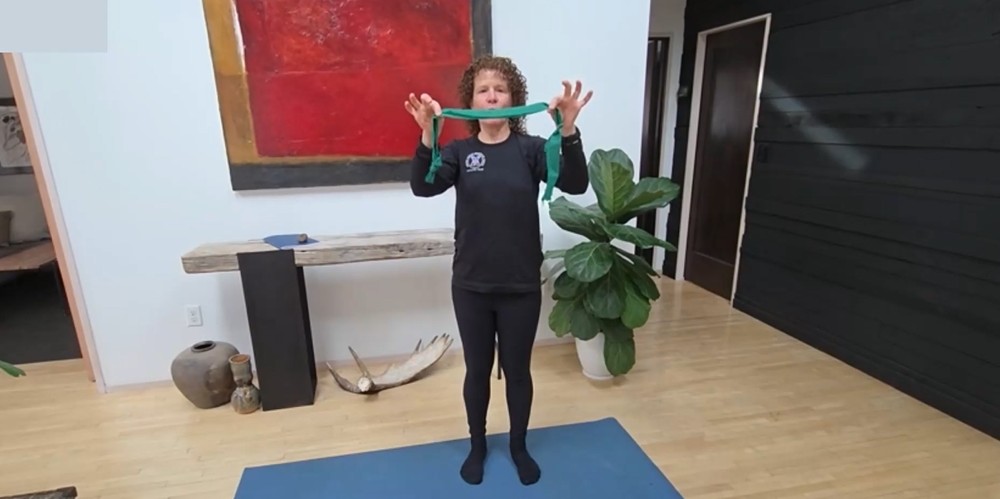
In this video Nikki explains the different types of exercise resistance bands.
Comparing Resistance Bands to Weights
These resistance bands are sheets or tubes of elastic material that create tension when stretched. Unlike weights that rely on gravity, bands provide consistent resistance throughout the entire range of motion. Resistance bands are excellent for targeting specific muscle groups and developing functional strength.
We are fans of both weights and resistance bands, and having access to both, if possible, is ideal. The nice thing about resistance bands is that they are inexpensive and take up little space. Prices typically range from $10-15 for basic bands to $15-50 for complete sets with accessories. For beginners, a set with 3-5 different resistance levels provides a good starting point.
Where to Buy Exercise Resistance Bands
Resistance bands are easily found online and in most sporting goods stores, including:
Sporting goods stores (Dick's, REI, etc.)
General retailers (Target, Walmart)
Online retailers (Amazon, Rogue Fitness)
Specialty fitness stores
Physical therapy supply shops
Considerations When Purchasing
Resistance level: Bands typically come in light, medium, heavy, and extra-heavy resistance (often color-coded). Beginners should start with lighter resistance.
Long vs. Loop bands: Bands are sold either as a circle or as a straight length of band (band sold in a roll fits this category). The loop bands, usually sold in a size that can wrap around both of your legs, are excellent for most lower extremity exercises. However, many exercises require a long band that is not in loop form. Further, long bands can be tied into a loop when a circle is needed. Manufactured circular bands are handy, sturdy. Having both is nice, but if you had to choose just one, we recommend set of long bands.
Length: Longer bands offer more versatility for different exercises. Buying a roll with several yards allows you to cut the length you want. Pre-cut bands can be sold in sets so you get a variety of resistance levels. Bands sold in a set often range from 3-5 feet long, and generally around 4 inches wide.
Set vs individual bands: Sets of bands are great, particularly if you are newer to exercise and not sure what resistance you need. You might want to start here and get a kit that has 3-4 levels of resistance. As you progress, you may find value in buying a longer roll of the resistance levels you like and then cutting them to your preferred size. You will learn as you go what works for you.
Width: Wider bands generally provide more resistance and durability.
Handles/attachments: Some long bands are sold with handles making them easy to grip. This can be helpful for people who have difficulty gripping smaller objects, or have less than optimal grip strength. Door anchors (additional purchase) attach the band to a door allowing for exercises requiring one end to be fixed to a sturdy object.
What Else Do You Need to Workout At Home?
The short answer is, very little. You do not need a dedicated room. Your "gym" can technically disappear when not in use. If you have a dedicated space to set aside for a gym, all the better.
The "Step-Out" Method for Working out At Home
Find a space where you can take one large step while opening your arms in a "T" in any direction without hitting furniture. Add another 6 inches or so and you have a gym.Read our full article on The 6-Square-Foot Gym: Everything You Need to Build Strength at Home which goes into detail on two other low cost items you should purchase in addition to exercise resistance bands.
Finding the Right Strength Training Program for Women Over 40
You might also be interested in our article taking a look at The Best At-Home Strength Training Programs for Women Over 40. Many programs and online apps are marketed to women over 40, but are they really effective? Our article takes a deep dive into the most popular apps targeting women over 40 and answers the question: What do women over 40 really need from a strength training program?