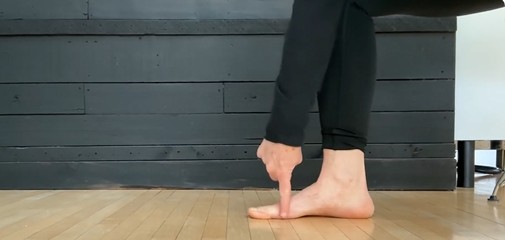
Foot Core Resource 1—The Foot Has a Core Too: Why Foot Strength is Important
At Every Woman Fitness, we don’t frame any one exercise approach as a guarantee against injury. What we can do is look at what the research suggests and help you apply it in a way that makes sense for your body and your life. Foot-core training is one area where the details matter.
Most of you are familiar with the idea of core strength.
We think about the trunk. The hips. The muscles that help control movement and stabilize the body. But there’s another core that gets far less attention: the foot.
At Every Woman Fitness, we don’t frame any one exercise approach as a guarantee against injury. What we can do is look at what the research suggests and help you apply it in a way that makes sense for your body and your life. Foot-core training is one area where the details matter.
This study focused on runners, so the discussion that follows is framed in that context. While direct evidence in other groups is limited, foot strength likely benefits anyone who spends time on their feet.
What Is the Foot Core?
The term foot core refers to the intrinsic muscles of the foot, the small muscles that originate and insert within the foot itself. These muscles help support the arch, control foot stiffness and adaptability, and manage how force is absorbed and returned with each step.
They function in a way that parallels the trunk. The trunk core stabilizes the spine so the limbs can move efficiently. The foot core stabilizes the base so force can be transferred efficiently.
Different location. Same job: control and force management.
What the Research Shows
A randomized controlled trial examined a structured foot-core training program in recreational runners.¹
Participants in the exercise group completed a supervised program three times per week for the first two months, then continued with remote guidance for the remainder of the year-long study.
The results were notable. Runners in the program were 2.4 times less likely to sustain a running-related injury. The protective effect did not appear immediately, but emerged after 4 to 8 months.¹
This is one of the stronger pieces of evidence supporting a specific strength intervention for runners.
Why This Study Matters
This was not general ankle strengthening. It was a progressive, targeted program built around how these muscles function.
It began with activation with a doming exercise. This move requires use the intrinsic foot muscles while minimizing compensation from larger extrinsic muscles. It then progressed to strength, adding load and repetition to build local tissue capacity. Finally, it moved to integration, applying that control during balance and movement and connecting foot strength to whole-body function.
You don’t get meaningful change by skipping steps or jumping straight to balance work.
Why Foot-Core Training Takes Time
One of the most important practical findings from the study is that the benefit did not show up right away.
It took 4 to 8 months before injury rates began to diverge between groups.
This tells us that foot-core training is not a quick fix. It is a capacity-building intervention that likely reflects both structural and neuromuscular adaptation over time.¹
This pattern should feel familiar. Bone adapts slowly. Tendon adapts slowly. The intrinsic foot system appears to behave the same way.
Foot Core vs Trunk Core: Similarities and a Critical Difference
The comparison to the trunk is useful, as long as we keep it grounded.
The trunk core helps control the position of the pelvis and spine, supports efficient movement patterns, and limits unnecessary motion. The foot core controls arch behavior and foot stiffness, manages ground reaction forces, and provides a stable base for propulsion.
In both systems, poor control leads to inefficient, and often excessive, load distribution. Improved control supports better force distribution and more efficient function.
A key difference is timeline. Trunk-focused work can improve movement relatively quickly. Foot-core training builds capacity more gradually. That difference matters when setting expectations.
What This Means in Practice
If you include foot-core work, keep it specific, progress from activation to strength to integration, and keep sessions short but consistent.
Expect results over months, not weeks. This study is about building capacity in a system that takes time to adapt.
The Takeaway
The foot is not just a passive structure. It has its own system of control and support.
Like the trunk, it responds to training. Unlike the trunk, it requires patience.
Build it over time, and it can meaningfully support your durability as a runner.
While the direct evidence in this study applies specifically to runners, we believe foot strength likely benefits anyone who spends time on their feet.
Reference
Taddei UT, Matias AB, Duarte M, Sacco ICN. Foot core training to prevent running-related injuries: a survival analysis of a single-blind randomized controlled trial. Am J Sports Med. 2020.