What Is a Resilient Body?
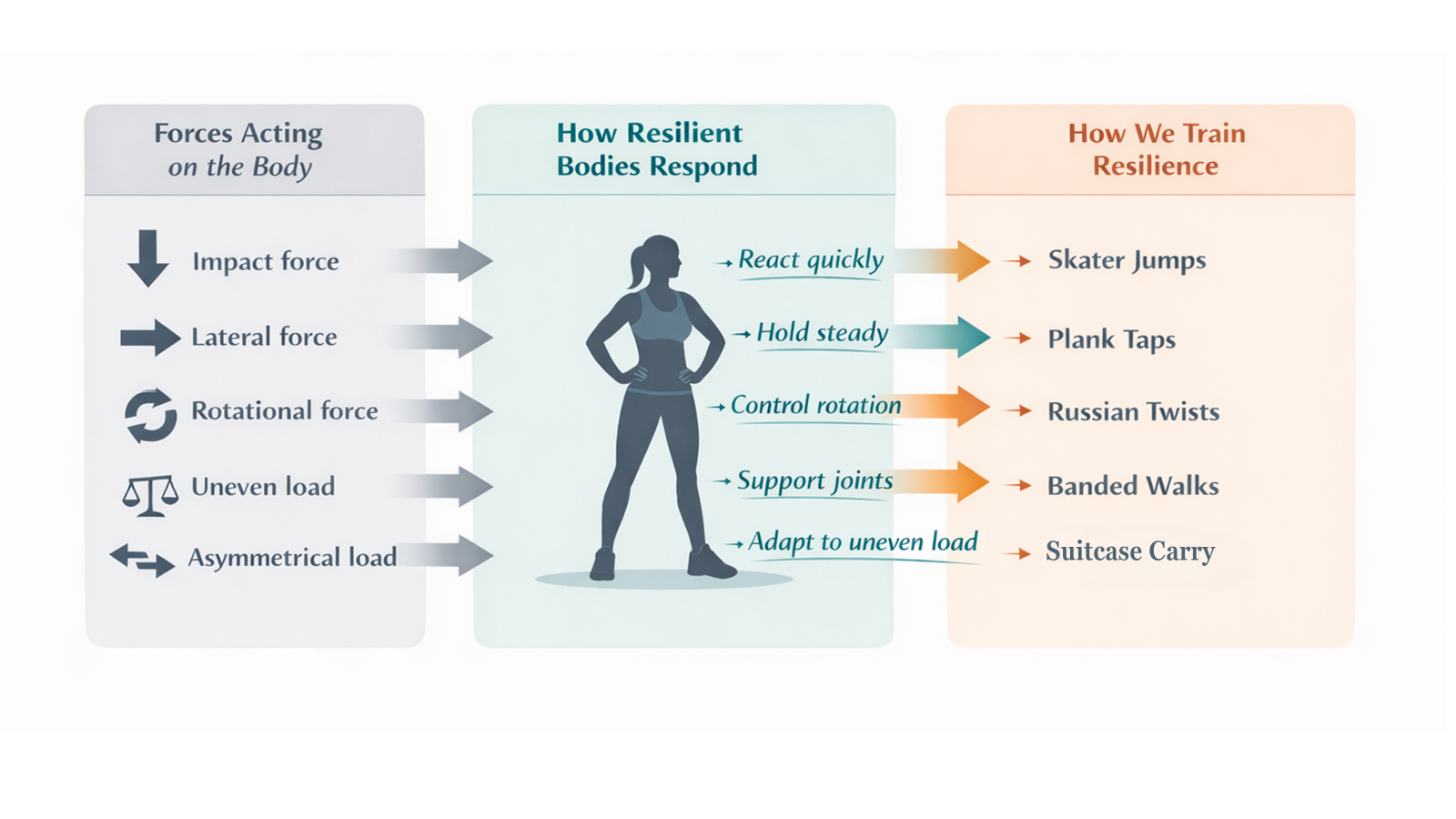
Resilience is often discussed in health and fitness, but what does it actually mean in the body? At Every Woman Fitness, we think of resilience as the ability to react, stabilize, support, and control movement under load. A resilient body does more than produce strength. It adapts to the forces of everyday life. In this resource, we explore five key strength skills that help build physical resilience and support confident, capable movement.
The word resilience appears everywhere in health and fitness. We talk about resilient athletes, resilient minds, and resilient communities.
But what does resilience actually mean in the human body?
Before answering that question, it helps to start with the basic definition of the word itself.
What “Resilience” Means
Most dictionaries define resilience as:
• the capacity to withstand or recover quickly from difficulties
• the ability of a material to absorb energy when deformed and return to its original shape
Engineers use the term to describe how materials respond to force. A resilient material can absorb stress without failing and return to form afterward.
The human body works in much the same way. Every step, reach, lift, or stumble introduces forces that the body must manage.
A resilient body does three things well:
responds quickly to force
maintains stability under load
returns to efficient movement afterward
Resilience is not simply strength. It is strength that adapts to changing conditions.
A Biomechanics Perspective
In biomechanics, movement can be understood as a constant exchange of forces.
When the foot hits the ground while walking or running, the body absorbs impact forces. Muscles and connective tissues then store and release energy to propel the body forward.
The trunk and hips stabilize the skeleton so that forces can move efficiently through the body.
When these systems work well together, the body can absorb force, redistribute it, and continue moving efficiently. That capacity is a key element of physical resilience.
How We Think About Physical Resilience at Every Woman Fitness
At Every Woman Fitness, we think of resilience as the ability to react, stabilize, support, and control movement under load. This requires multiple forms of strength working together.
Next we cover how our programming trains the five key elements of physical resilience.
Strength that reacts
Life rarely moves in straight lines. Reactive strength allows the body to absorb force, stabilize, and move again when direction suddenly changes. This helps protect us during slips, stumbles, and rapid changes of direction.
Strength that holds
Strong movement begins with a steady center. When the trunk stays stable, the limbs can move efficiently and safely. Exercises that challenge trunk stability build the ability to maintain alignment even as forces act on the body.
Strength that supports
The hips provide essential support for the pelvis and knees. Lateral hip strength helps maintain alignment during walking, climbing stairs, running, and skiing. Without this support, movement becomes less efficient and joints absorb unnecessary stress.
Side Lie Gluteus Medius Matrix
Strength under uneven load
Most daily tasks involve uneven loads. Carrying groceries, lifting luggage, or holding a child challenges the body to stabilize while weight pulls to one side. Training asymmetrical loading builds durability in the trunk and hips.
Strength that controls rotation
Many daily and athletic movements involve rotational forces. Resilient bodies do not simply create rotation—they control it. Rotational strength allows forces to move safely through the trunk and helps protect the spine.
Why Variety Matters
A resilient body is not built with a single exercise. It develops through movements that challenge the body in different ways: reacting, stabilizing, supporting, and controlling force.
Training these qualities improves the body’s ability to move confidently through everyday life and physical activity. That is the goal of resilience training.
PT Perspective
From a physical therapist’s perspective, resilience is closely tied to how the body manages force.
Much of injury prevention and rehabilitation focuses on helping the body stabilize the trunk, maintain hip control, and respond effectively to changing loads.
Exercises that train balance, trunk stability, hip strength, and reactive movement all contribute to building a resilient body.