Beyond Crunches: A Guide to Functional Core Training
At Every Woman Fitness, we believe core strength involves much more than your abdominal muscles. From your deep spinal stabilizers to your hips and shoulders, a strong core supports coordinated movement throughout your body. Learn why we prioritize compound exercises while still making room for targeted core training.
If you've spent much time in gyms or following fitness programs, you've probably encountered workouts devoted entirely to abdominal exercises. Crunches, sit-ups, leg raises, and planks have become such familiar features of strength training that a workout without them might seem incomplete.
So you may have noticed something curious about Every Woman Fitness: We don't prescribe nearly as many traditional abdominal exercises as you might expect.
We haven't forgotten your abdominal muscles. In fact, we're asking them to work throughout much of your strength training. To understand why, we need to look beyond the familiar six-pack and explore what your core actually does.
Your Core Is More Than Your Abs
Editor’s note: This broader view of the core isn't new to our approach. Back in 2011, Every Woman Fitness co-founder Nikki Kimball, MSPT, wrote about the gluteal muscles as the "forgotten core" in Runner's World magazine, emphasizing the importance of pelvic stability and hip strength for runners. By then, more than a decade of experience as both a physical therapist and professional athlete had taught her to look beyond the traditional six-pack definition of core strength. The same principle extends well beyond running: Strong, coordinated movement depends on much more than abdominal strength alone.
When someone mentions abdominal strength, the muscle that often comes to mind (even if not by its Latin name) is the rectus abdominis. This long muscle runs down the front of your abdomen and is responsible for much of the highly sought-after six-pack appearance. It's an important muscle. It flexes the trunk, helps control spinal extension, and contributes to trunk stability. Exercises such as crunches and sit-ups can strengthen it, and there's nothing wrong with including them in a training program. But the rectus abdominis is only one member of a much larger team.
Your external and internal obliques wrap around the sides of your trunk, contributing to rotation, side bending, and control of spinal movement. The transversus abdominis, your deepest abdominal muscle, helps regulate abdominal pressure and contributes to trunk stiffness. Around the back, the erector spinae help extend and support the spine, while the multifidus muscles help produce and control movement between vertebral segments. Your diaphragm and pelvic floor also participate in the pressure-management system that supports your trunk.
In other words, your core is three-dimensional. At Every Woman Fitness, we also think about core function more broadly, including the muscles that stabilize your hips and shoulder girdle. These close-to-the-body joints provide important foundations for the movements of your arms and legs. Together, these muscular systems help us produce and control movement in multiple directions.
Training only the muscles visible in the mirror would leave much of that system out of the conversation.
Meet the Multifidus: An Underappreciated Member of the Team
Deep along the back of your spine lies a series of small, overlapping muscles called the multifidi. Their short bundles of muscle fibers connect vertebrae across relatively small distances, giving them an important role in controlling movement between spinal segments. Unlike the rectus abdominis, the multifidus is unlikely to feature prominently in advertisements for summer swimwear. But its anatomy is fascinating, and its contributions to spinal function deserve attention.
The multifidus works with the larger trunk muscles to produce and control movement. It is particularly interesting to physical therapists because changes in multifidus size, activation, and muscle composition have been associated with low-back pain. That doesn't mean a weak multifidus necessarily causes back pain, or that strengthening it will prevent back injuries. The relationship between spinal muscles and pain is considerably more complex, and a topic for another article (or better yet, a book).
Fortunately, the multifidus is trainable. Like the more familiar muscles across the front of your abdomen, these deep spinal muscles respond to the demands we place upon them and deserve consideration in a comprehensive strength program.
Sometimes the Core's Job Is to Prevent Movement
Think about a suitcase carry. You're holding a heavy weight in one hand, and gravity is trying to pull your trunk sideways. Your abdominal, hip, and spinal muscles work together to help you maintain your position while you walk. Or picture a Romanian deadlift. Your hip extensors do much of the work of raising your trunk, but your spinal extensors and abdominal muscles contribute to maintaining and controlling spinal position under load.
In either case, your core is doing meaningful work, even though you're not performing what most people would consider a traditional abdominal exercise.
This is one reason we like compound exercises, which involve movement at multiple joints and recruit several muscle groups simultaneously. They allow us to challenge trunk control while training other important muscles. And as resistance increases appropriately, the demands on the trunk can increase too.
Does That Mean Squats Replace Crunches?
Not exactly.
Research using electromyography, or EMG, demonstrates that many resistance exercises activate multiple trunk muscles, including the obliques, rectus abdominis, and spinal extensors. Systematic reviews have found substantial activation of several core muscles during free-weight exercises, although the amount of activity varies considerably by muscle and exercise. Some muscles may be challenged more effectively by targeted core exercises.
Muscle activation, however, is not the same thing as a demonstrated increase in muscle strength. EMG measures electrical activity associated with muscle contraction. It doesn't directly establish how much strength or muscle growth an exercise will produce over months of training.
Different exercises also challenge different trunk muscles in different ways. A heavy deadlift may place considerable demands on the spinal extensors without providing the same stimulus to the rectus abdominis as a targeted abdominal exercise.
So we aren't suggesting that compound movements make dedicated abdominal exercises obsolete. We're suggesting that abdominal and trunk training happen in more places than the abdominal section of a workout.
Why We Still Include Targeted Core Exercises
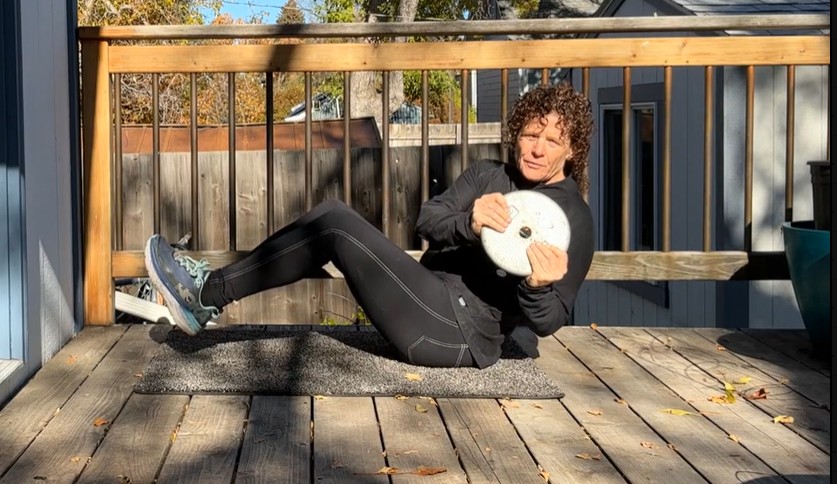
If you've completed an Every Woman Fitness program, you've encountered exercises such as transversus abdominis activation, dead bugs, bird dogs, Pallof presses, and plank variations.
These exercises give us opportunities to focus on particular aspects of trunk control without simultaneously managing the demands of a heavy squat, lunge, or deadlift. Sometimes that focused attention is useful. We may want to teach someone to recognize and control trunk movement, improve endurance in a particular position, or strengthen a muscle group that needs additional work.
Then we can challenge those abilities in more complex movements.
In physical therapy, we frequently use targeted exercises to address specific weaknesses or movement impairments, then incorporate those gains into more demanding activities. Developing strength in a relatively simple movement and learning to use that strength during a complex task are related, but not necessarily identical, processes.
Both approaches have value.
What Are We Actually Training For?
There's nothing wrong with wanting well-defined abdominal muscles. Targeted abdominal training can help develop those muscles, although their visibility depends on more than strength alone. Muscle size, individual anatomy, genetics, and the distribution of fat over the abdominal wall all contribute to their appearance.
At Every Woman Fitness, our primary goal is to help you develop the strength and physical capacity to participate fully in the activities that matter to you, for as long as possible. That includes lifting, balancing, exercising, and moving confidently through daily life. Your trunk muscles play important roles in all these activities, but they don't work alone. They coordinate with your hips, shoulders, and limbs to produce and control movement.
This is why our programs combine compound strength exercises with selected targeted core work. We want to develop individual muscular capacity while also challenging the body to use that capacity in coordinated movement. And we want to accomplish that without requiring you to spend every spare hour exercising.
So, where have all the crunches gone?
They haven't disappeared because we think they're bad exercises. They simply aren't the only way, or necessarily the most useful way for our goals, to train the remarkable collection of muscles we call the core.
Your abs have been working all along.
They just haven't been demanding all the attention.
References
Martuscello JM, Nuzzo JL, Ashley CD, Campbell BI, Orriola JJ, Mayer JM. Systematic review of core muscle activity during physical fitness exercises. Journal of Strength and Conditioning Research. 2013;27(6):1684–1698. https://doi.org/10.1519/JSC.0b013e318291b8da
Oliva-Lozano JM, Muyor JM. Core muscle activity during physical fitness exercises: A systematic review. International Journal of Environmental Research and Public Health. 2020;17(12):4306. https://doi.org/10.3390/ijerph17124306
Currier BS, et al. American College of Sports Medicine Position Stand: Resistance Training Prescription for Muscle Function, Hypertrophy, and Physical Performance in Healthy Adults: An Overview of Reviews. Medicine & Science in Sports & Exercise. 2026;58(4):851–872. https://doi.org/10.1249/MSS.0000000000003897