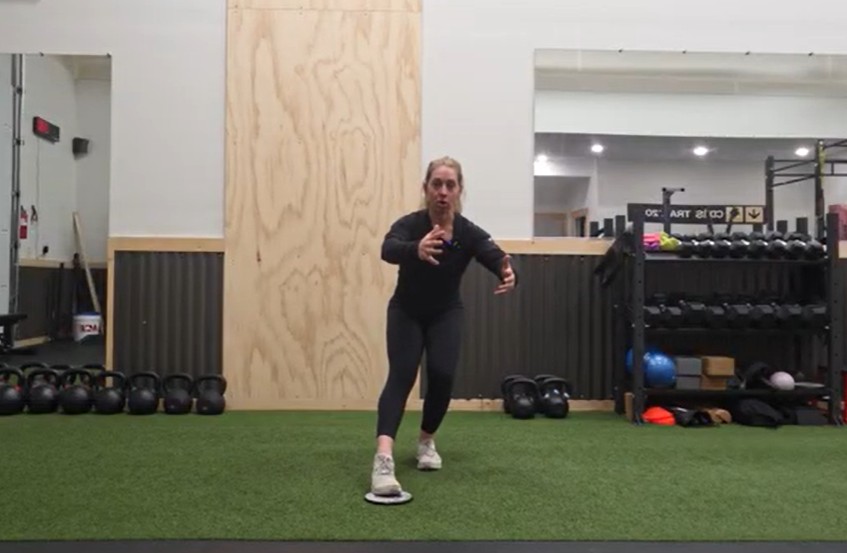
Getting Started With Sliders
Sliders are a compact, inexpensive tool that turn bodyweight movements into joint-friendly strength and stability training. By reducing friction, they force your hips, core, and shoulders to control motion through the entire range, building eccentric strength and balance. Expect stronger hips, a more connected core, and smoother movement patterns with consistent practice.
Sliders: Small Tool, Big Payoff
Along side resistance bands, sliders are some of the easiest and most space-efficient training tools you can own. Whether you use furniture sliders, microfiber cloths, or core sliders, they take up almost no storage space and instantly turn simple movements into powerful strength, stability, and mobility training. Think of them as TheraBands' little sisters.
Equipment Options
You do not need exercise-branded sliders, though they are inexpensive and widely available.
Low-cost options that work perfectly:
Carpet: smooth plastic furniture sliders
Hardwood or tile: felt-bottom sliders, socks, microfiber cloths, or paper plates
Goal: reduce friction so your muscles, not momentum, create the resistance
Easy, affordable online options:
Amazon: Core-slider style discs ($7–10 per pair) or dual-surface sliders compatible with carpet and hardwood ($8–12)
Home Depot: Everbilt 6" furniture sliders for carpet ($5–7 for a 4-pack)
Sliders take up roughly the space of a small book and fit easily into any drawer or gym bin.
Why We Use Sliders in Forever Strong
Sliding reduces friction, which dramatically increases the muscular control required to move your limbs. This challenges the hamstrings, glutes, adductors, deep core, and pelvic stabilizers, as well as upper-body and periscapular muscles including the serratus anterior, lower trapezius, rhomboids, and rotator cuff during plank-based variations.
For women in midlife, this style of work supports knee health, hip stability, shoulder health, balance, and long-term resilience. Sliders also allow progressive overload without adding external weight, making them ideal for home gyms, travel, or days when a joint-friendly training stimulus is preferred.
Evidence Behind Slider Training
Sliders are widely used in physical therapy clinics, sports-performance facilities, and athletic training programs because they reliably increase eccentric control, enhance joint stability, and challenge neuromuscular coordination.
One particularly relevant study is:
Effects of an Eccentric Training Protocol Using Gliding Discs on Balance and Lower Body Strength in Healthy Adults
(2021, PubMed ID: 34945261)
This study found meaningful improvements in lower-body strength, balance, and eccentric control following a structured training program using gliding discs. The findings reinforce why sliders appear in Forever Strong: reducing friction increases muscular demand in a joint-friendly way and strengthens the control systems that protect the knees and hips over time.
If you enjoy a deeper academic dive into training tools, this study is an excellent place to start.
Slider Exercises You Will See in Forever Strong
We begin with the Hamstring Slider, one of the most effective ways to build eccentric hamstring capacity and posterior-chain strength. Over time, you will see additional progressions such as:
Reverse lunge sliders
Lateral lunge sliders
Adductor slides
Mountain climber sliders
Core tuck sliders
Pike sliders
Single-leg reach and balance sliders
Upper-body slider planks including reaches, circles, and alternating slides
Each new variation is introduced gradually to develop control before adding range or speed.
Tips for Success
Move slowly at first. Sliders magnify any loss of tension.
Keep your ribcage down and pelvis quiet.
Shorten the range if you feel hamstring gripping or low-back tension.
For upper-body variations, “push the floor away” to activate the serratus and stabilize the shoulder blades.
If a slider sticks, switch surfaces or place a microfiber cloth underneath.
Common Errors
Knees collapsing inward
Moving too quickly
Over-arching the low back
Letting the shoulder blades collapse during plank-based movements
These tend to improve quickly with consistent practice and better control.
Bottom Line
Sliders provide a simple, low-cost way to build strength, balance, and controlled mobility. They are ideal for small spaces and travel, and they pair well with traditional lifting because they demand full-range control rather than momentum. Expect stronger hips, a more integrated core, healthier shoulders, and smoother, more powerful movement patterns.