The Hinge Family of Exercises
The hip hinge is one of the most important movement patterns you'll ever learn. Discover how mastering this foundational movement improves deadlifts, strengthens everyday movement, and makes dozens of exercises easier to learn. The first article in our Movement Families series.
The Importance of Movement Families
Most fitness programs teach exercises.
At Every Woman Fitness, we teach the movement patterns that connect them.
Rather than memorizing dozens of individual exercises, you'll learn a handful of fundamental movement families. Once you understand a movement family, learning new exercises becomes easier because you're building upon skills you've already developed. Better muscle activation, improved alignment, and more efficient movement don't stay with one exercise—they carry forward into many others and into everyday life.
This article is a part of our Movement Families series.
Mastering the Hinge: The Movement Pattern Behind Strength, Confidence, and Everyday Life
If you've spent much time exploring Every Woman Fitness, you've probably noticed something: we spend a surprising amount of time teaching the hip hinge. We have videos devoted entirely to learning this movement, beginning with isolated hinge drills using a dowel for feedback, progressing through seated and standing variations, and eventually introducing Romanian deadlifts, conventional deadlifts, kettlebell swings, and other hinge-based exercises.
To some people, that may seem like a lot of attention devoted to a single movement. We see it differently. At Every Woman Fitness, we don't simply teach exercises—we teach the movement patterns that make those exercises possible. Once you understand a movement pattern, learning new exercises becomes easier because each one builds upon skills you've already developed. The hinge is one of the best examples of this philosophy, and one of the reasons you'll encounter it repeatedly throughout our programs.
The Hinge Is Everywhere
Long before it became a gym exercise, the hinge was simply part of everyday life. You perform some version of it every time you pick something up from the floor, unload the dishwasher, carry groceries, lift a bag of dog food, pull weeds, or pick up a child or grandchild. Whether you realize it or not, the hinge is one of the most common movement patterns you'll perform throughout the day.
A hinge occurs when your hips move backward as your torso tips forward while your spine remains relatively stable. Rather than bending primarily through your back, the movement is driven by your hips, allowing your glutes, hamstrings, and abdominal muscles to work together to create a strong, stable trunk while generating force through your legs. When performed well, the hinge allows everyday tasks to feel stronger, more efficient, and often more comfortable.
Why We Teach the Hinge Movement Before the Exercise
Every good strength program teaches exercises. At Every Woman Fitness, we also teach the movement patterns that connect those exercises.
Think about learning a new language. Once you've learned the alphabet, every new word becomes easier to understand. Movement works in much the same way. When you learn a hinge well, you're not simply becoming better at one exercise. You're teaching your nervous system how to organize muscle activation, maintain alignment, stabilize your trunk, and generate force efficiently through your hips. Those skills carry forward into every exercise built upon that same movement pattern.
That means you're not starting over each time you learn something new. Instead, each exercise reinforces skills you've already developed while introducing only a few new elements. Over time, movement becomes more natural, technique improves more quickly, and you gain more from every repetition you perform.
This philosophy is one reason you'll often find us spending more time teaching movement than adding more exercises. We'd rather help you build a foundation that lasts than simply expand a list of exercises you've tried.
Romanian deadlifts, conventional deadlifts, single-leg deadlifts, kettlebell swings, good mornings, and many athletic movements all rely on the same fundamental hinge pattern. While each exercise has its own purpose and technical nuances, they all build upon the same underlying movement. Rather than memorizing dozens of unrelated exercises, you're learning one movement family that can be applied in many different ways.
Most People Don't Naturally Hinge Well
Ironically, hinging is one of the least intuitive movement patterns for many adults. We spend years bending over, sitting, reaching, and lifting without ever thinking about how we're moving, so it's completely normal for the hinge to feel awkward when you first begin practicing it.
Instead of moving primarily through the hips, people commonly:
Bend through the lower back.
Squat instead of hinging.
Reach toward the floor with the arms instead of sending the hips backward.
Shift their weight onto their toes.
Lose abdominal engagement.
Keep the hips either too high or too low for the task at hand.
None of these are signs that you're "bad" at deadlifts or strength training. They simply tell us that your brain hasn't yet learned this particular movement pattern. Like skiing, dancing, or riding a bicycle, coordination improves through thoughtful practice. Feeling awkward at first isn't a problem. It's simply part of learning.
Why We Teach the Hinge in Stages
One of our core beliefs at Every Woman Fitness is that movement quality develops through practice. We don't expect anyone to perform a beautiful deadlift on Day One. Instead, we expect you to understand the movement a little better each time you practice it.
For that reason, we teach the hinge progressively. We begin with simple drills that help you feel your hips moving backward and understand what a stable trunk feels like. As the movement becomes more familiar, we gradually introduce more challenging variations and eventually external resistance. Each stage builds upon the one before it, allowing your brain and body to solve one or two new problems at a time instead of ten all at once.
Although it may seem slower at first, this approach is often the fastest path toward developing a confident, efficient hinge.
Our Hinge Progression
Everyone learns a little differently, which is why we've included several instructional videos throughout this progression. One explanation may immediately click for one person, while another person responds better to a completely different cue. There isn't one perfect cue. The best cue is the one that helps you understand the movement.
Many people progress through a sequence similar to this:
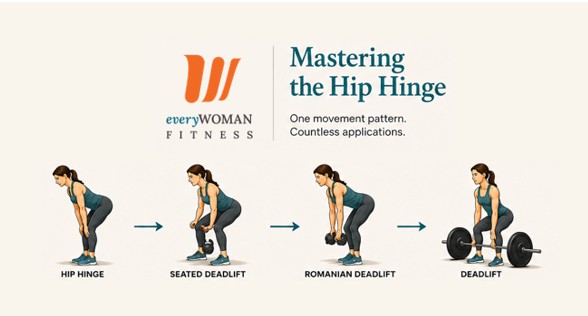
Hip hinge drills using a dowel for feedback. See our video demonstration here.
Hip hinge drills using external cues, such as reaching the hips toward a wall or imagining your hands are full of groceries while you close the car door with your hips.
Seated deadlift to reinforce hip movement while reducing balance demands.
Bodyweight Romanian deadlift.
Dumbbell Romanian deadlift.
Dumbbell deadlift.
Barbell Romanian deadlift.
Barbell deadlift.
Don't worry if you spend extra time at one stage. Learning movement isn't a race, and the goal isn't simply to reach the barbell. The time you spend developing a quality movement pattern pays dividends every time you perform a hinge-based exercise, whether that's during a workout or while lifting something heavy in everyday life.
Helpful Cues When Hinging
As you work through the progression, don't try to remember every cue at once. Pick one or two that make sense to you and let the others fade into the background. Different people learn in different ways, and that's exactly why we've included several teaching videos throughout this resource.
Some cues that many people find helpful include:
Begin the movement by sending your hips backward rather than bending your knees first.
Imagine your hands are full of grocery bags and you need to close the car door with your hips.
Allow your knees to soften naturally rather than locking them straight.
Feel your weight shift toward your heels rather than drifting onto your toes.
Imagine your pelvis and trunk forming one long, solid plank that tips forward from the hips.
Think about making yourself long rather than trying to stay perfectly upright.
Keep your shins relatively vertical to avoid turning the movement into a squat.
Experiment with different cues and keep the ones that help you move naturally and confidently.
PT Perspective on Hinging
One of the biggest changes I've made during my career as a physical therapist isn't what I teach, but how I teach it.
Early in my career, I often tried to teach the deadlift itself during a single treatment session. Many people returned the following week performing something that resembled a deadlift, but repeated practice had also reinforced several compensations that we now had to undo before moving forward. Over time, I realized it was far more effective to spend that first visit teaching the hinge itself.
Today, I often ask people to practice the hinge frequently between visits without worrying about lifting heavy weight. When they return with a solid understanding of the movement, teaching Romanian deadlifts, conventional deadlifts, kettlebell swings, and other hinge-based exercises becomes dramatically easier. Rather than learning each exercise from scratch, they're simply applying a movement pattern they already understand.
Whether your goal is to become stronger in the gym, garden more comfortably, carry grandchildren, or simply move through life with greater confidence, learning to hinge well pays dividends across countless activities. That's why the hinge appears so often throughout Every Woman Fitness Programs. We're not simply teaching a deadlift: we're helping you develop a movement pattern you'll use for the rest of your life.
References:
Currier BS, D'Souza A, Fiatarone Singh MA, et al. American College of Sports Medicine Position Stand. Resistance Training Prescription for Muscle Function, Hypertrophy, and Physical Performance in Healthy Adults: An Overview of Reviews. Medicine & Science in Sports &Exercise. 2026;58(4):851-872.
American College of Sports Medicine. ACSM's Guidelines for Exercise Testing and Prescription. 12th ed. Philadelphia, PA: Wolters Kluwer; 2025.
Suchomel TJ, Nimphius S, Stone MH. The Importance of Muscular Strength in Athletic Performance. Sports Medicine. 2016;46:1419-1449.
Nelson ME, Rejeski WJ, Blair SN, et al. Physical Activity and Public Health in Older Adults: Recommendation from the American College of Sports Medicine and the American Heart Association. Medicine & Science in Sports & Exercise. 2007;39(8):1435-1445.
McGill SM. Low Back Disorders: Evidence-Based Prevention and Rehabilitation. 4th ed. Champaign, IL: Human Kinetics; 2016.
Schmid S, Dörge HC, et al. The Stoop-Squat Index: A Simple but Powerful Measure for Quantifying Whole-Body Lifting Behavior. Applied Sciences. 2021;11(21):10309.