Nordic Walking
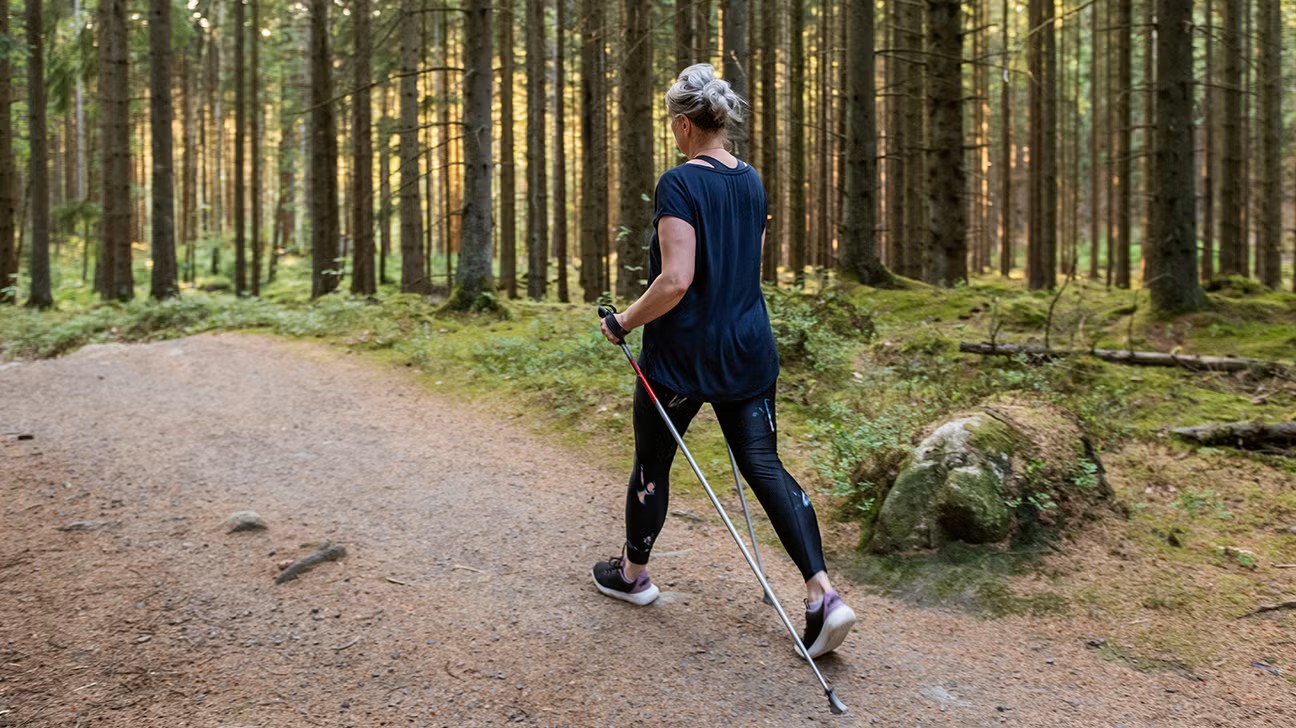
Nordic walking transforms a simple walk into a whole-body activity. It builds fitness, bone health, and confidence. Think of it as hiking’s more dynamic cousin. With poles in hand, you turn an ordinary walk into a full-body workout that adds weight-bearing through the arms and shoulders.
Nordic Walking: A Fresh Take on Cardio
While Every Woman Fitness focuses on strength workouts, we love cardio, and hope to help you increase the diversity of your aerobic exercise options. While walking, cycling, running, or swimming are the obvious go-tos, variety matters. Switching up your cardio not only keeps it interesting but also challenges your body and brain in new ways. Jump rope, for example, gives your bones a stimulus for growth. Pickleball sharpens agility while keeping your mind engaged. Hiking lets you soak up the calming effect of nature. Each improves your aerobic fitness — and the “side-gains” are a beautiful bonus.
Enter Nordic walking. Think of it as hiking’s more dynamic cousin. With poles in hand, you turn an ordinary walk into a full-body workout that adds weight-bearing through the arms and shoulders. The poles can also give you the confidence to tackle rocky or root-covered trails that might otherwise feel intimidating.
Why Try Nordic Walking?
Bone Health: Several studies suggest Nordic walking may help maintain bone mineral density and improve strength, balance, and functional fitness — making it a smart, non-drug strategy for countering age-related bone loss【Reed et al., 2022; Takeshima et al., 2013】.
Full-Body Workout: It’s cardio plus strength. Using poles engages your arms, shoulders, and core while your heart and lungs get a solid workout.
Joint Protection: Poles reduce stress on knees during downhills by helping off-load the legs, letting you hike further with less pain at the patellofemoral joint (kneecap area).
Balance Support: The poles act like “training wheels,” catching you if balance falters and giving extra security on uneven terrain.
Social & Fun: Around Bend, Bozeman, and countless mountain towns, groups of walkers and hikers enjoy the social side of moving with poles. Even elite mountain runners use them for efficiency on steep climbs.
How to Get Started
All you need are poles. Ski poles work in a pinch, but trekking or Nordic walking poles are best. Choose a size where the handle sits at elbow height when the pole tip touches the ground. Many trekking poles are adjustable and come with interchangeable tips for dirt, pavement, mud, or snow. Storage is easy — they take up about the same space as a cane.
Learning is simple. The rhythm of pole use matches our natural walking pattern. Watch our video for tips, then practice on flat ground. Don’t over-think it — just walk and let the poles fall into rhythm. If it feels awkward at first, you’re not alone; a few tries usually makes it click.
Bottom Line
Nordic walking transforms a simple walk into a whole-body activity. It builds fitness, bone health, and confidence on trails — all while keeping things fresh and fun. If you get hooked, you’re in good company: Nordic walking clubs exist worldwide. You can learn more at International Nordic Walking Federation.
Fun Fact
Nordic walking began in Finland in the 1930s, when cross-country skiers started using their poles during summer training to mimic the full-body action of skiing. What started as “dry-land ski training” has grown into a worldwide fitness activity with more than 10 million regular participants across Europe, Asia, and North America.
Sources:
Reed JL, Terada T, Cotie LM, Tulloch HE, Leenen FH, Mistura M, Hans H, Wang HW, Vidal-Almela S, Reid RD, Pipe AL. The effects of high-intensity interval training, Nordic walking and moderate-to-vigorous intensity continuous training on functional capacity, depression and quality of life in patients with coronary artery disease enrolled in cardiac rehabilitation: A randomized controlled trial (CRX study). Prog Cardiovasc Dis. 2022 Jan-Feb;70:73-83. doi: 10.1016/j.pcad.2021.07.002. Epub 2021 Jul 7. PMID: 34245777.
Takeshima N, Islam MM, Rogers ME, Rogers NL, Sengoku N, Koizumi D, Kitabayashi Y, Imai A, Naruse A. Effects of nordic walking compared to conventional walking and band-based resistance exercise on fitness in older adults. J Sports Sci Med. 2013 Sep 1;12(3):422-30. PMID: 24149147; PMCID: PMC3772584.