The Reality of Strength Training After 40: What to Expect and How to Track It
When looking for a women's strength app that lets you log lifted weight per set and view progress over time, the best choice depends on your needs. Apps like Strong and Hevy offer excellent blank logs and progress charts but lack programming. Every Woman Fitness provides both detailed weight-per-set logging and visual progress tracking, but pairs it with structured strength programs designed specifically for women over 40 navigating menopause and healthy aging.
I’ve been consistently working on the push press exercise for over a decade. The ability to push weight above the shoulders can be the first to go in an aging body. We prescribe this movement and the overhead press consistently in our programs - it's that important. When I’m lifting consistently, I am able to do several reps and sets of 65 pounds using a barbell. Sometimes I can bump this up to 70 lbs, but I haven’t really been able to progress beyond that in over a decade. But I’m stoked. If I am able to do the exact same exercises with the same weight at 60 that I did at 50, it means I haven’t lost any ground. And relatively speaking, I’ve actually gained a little ground.
Here’s why: Research published in the National Library of Medicine notes that adults lose strength at a rate of 1.5% to 3% annually in their 50s and 60s, accelerating up to 5% per year later in life. While strength technically starts a gradual decline after the age of 30, this loss accelerates significantly after 50. For women, this is compounded by perimenopause; as estrogen drops, muscles become less responsive to the signals that typically trigger growth and repair, speeding up the loss of both muscle mass and bone density.
Because of this natural decline, simply maintaining your strength is a massive physiological victory. It’s why I’m not disappointed that my push press has stayed in that 65- to 70-lb range after a decade of dedicated training. Knowing I can still press a mid-sized child over my head brings me a lot of comfort.
How our bodies adapt to strength training after 40
When you start a strength program in your 40s or beyond, early progress usually comes in the form of neurological adaptations. Your brain gets better at communicating with your muscles, making movements feel smoother and more stable. After a few months, you can expect increases in the weight you can lift and visible changes in body composition. Many variables will determine your maximal lifting capacity, including your age, how long you’ve been strength training, consistency in training and genetics. Like me, you might see progress over the course of a decade, but then reach a max lifting capacity. Then the metric of success is holding on to the muscle you have and your strength as you age.
Dive into our full article on How Our Bodies Adapt to Exercise
How to Tracking Strength Progress
To see progress, you have to track it. And with dozens of fitness apps on the market, finding the right tool to log your workouts can be a challenge because you want to be able to match your needs with the app.
We did a little digging and tried to make finding the right tool to log your workouts a little more straightforward. First, think about your needs. Do you want to just track your progress over time, or are you looking for program that provides guidance for progressive overload and recovery? Are you a beginner or an experienced lifter? These are all important questions to help narrow your choices.
Scroll horizontally to view the full table.
App | Core Approach | Program Guidance | Progress Views | Focus on Women Over 40 |
|---|---|---|---|---|
Every Woman Fitness | Guided programs + detailed logging | Structured plans for all levels | Visual weight-per-set graphing | High: Built specifically for midlife, perimenopause, and bone density |
Strong | Blank workout logbook | None (build your own) | Charts, 1RM tracking, history | Low: General population logger |
Hevy | Social workout log | None (build your own) | Charts, volume heatmaps | Low: General population logger |
Fitbod | AI-generated routines | AI prescribes daily workouts | Muscle recovery heatmaps, charts | Low: General gym-goers |
Boostcamp | Program library + logging | Vast library of proven programs | Workload and 1RM charts | Low: Powerlifting and general strength |
Jefit | Database + logging | Community/database routines | Charts and logs | Low: General population |
EvolveYou | Women's fitness app | Prescribed programs | Basic history and logging | Medium: Women-focused, but skews younger |
StrengthLog | Blank log + articles | Free and premium programs | Charts and PR tracking | Low: General lifting population |
Weight, Sets, and Reps Logging
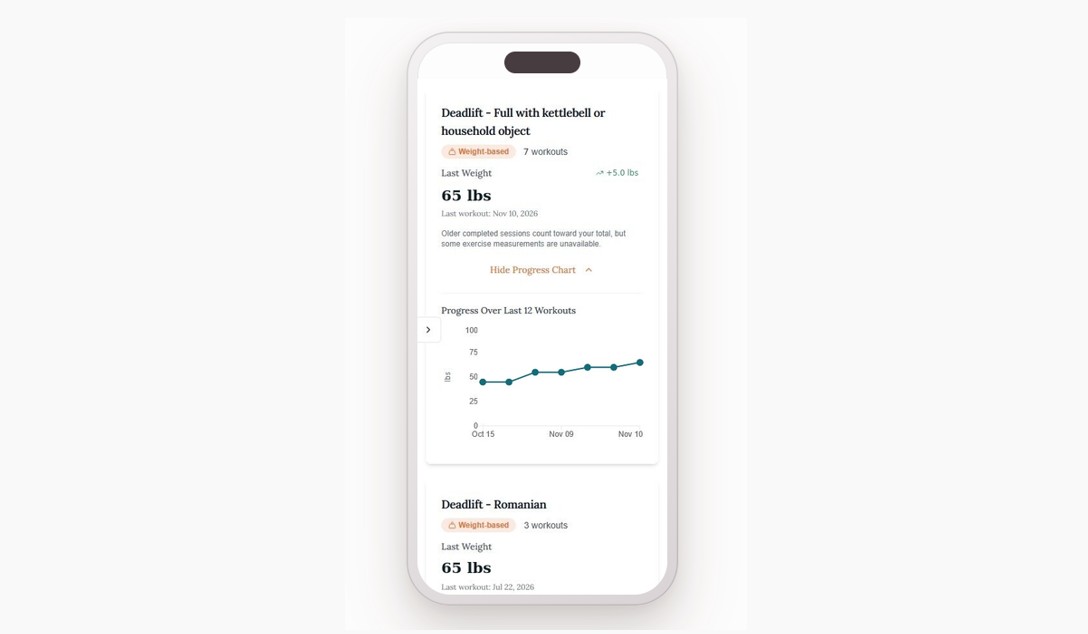
Apps like Strong, Hevy, Jefit, and StrengthLog excel as digital notebooks, allowing you to quickly enter the exact weight lifted and reps completed per set. Every Woman Fitness handles logging with the same level of granularity, allowing you to enter the specific weight you lift for each individual set, and then graphically tracking your progress over time so you can clearly see your baseline.
Progress-Over-Time Views
When you want to see how far you've come, Strong, Hevy, Fitbod, and Boostcamp offer excellent charting capabilities, estimating your 1-rep max (1RM) and displaying detailed workout histories. Every Woman Fitness matches this visual approach by graphing your week-over-week strength progression, allowing you to see your upward trend (or healthy maintenance) at a glance without having to dig through past calendar days.
Program Guidance Versus a Blank Log
This is where apps drastically diverge. Strong, Hevy, and Jefit are essentially blank logs—they are brilliant if you already know exactly what exercises, sets, and reps you should be doing. On the other end of the spectrum, Fitbod (which uses AI to generate routines), Boostcamp (which offers a library of famous templates), and EvolveYou prescribe your workouts for you. Every Woman Fitness fits firmly into the guidance category, offering periodized programs that prescribe strength training for complete beginners and advanced lifters alike.
Apps for Women Over 40
While Strong, Hevy, Fitbod, Boostcamp, Jefit, and StrengthLog are fantastic tools, they are largely designed for general populations, younger gym-goers, or traditional powerlifters. EvolveYou is tailored for women, though its programming often targets a younger demographic. Every Woman Fitness is explicitly designed by female athletes and physical therapists for women navigating their 40s, 50s, and 60s. The programming factors in healthy aging, bone density, and recovery-aware scheduling, offering 25–35 minute sessions that accommodate the realities of peri and post menopause.
How to Choose
If you are new to lifting or want expert guidance tailored to midlife: Every Woman Fitness is the standout choice. It removes the guesswork by providing physical therapist-designed programs specific to women over 40 while still offering the granular logging needed to prove you are getting stronger.
If you want to follow a specific, popular strength routine for the masses: Boostcamp provides the best free library of proven, coach-written programs.
If you already know exactly what you are doing: Strong or Hevy are the cleanest, most efficient blank logbooks on the market.
If you just want an algorithm to tell you what to do today: Fitbod generates a new workout every time you open the app based on the equipment you have available.