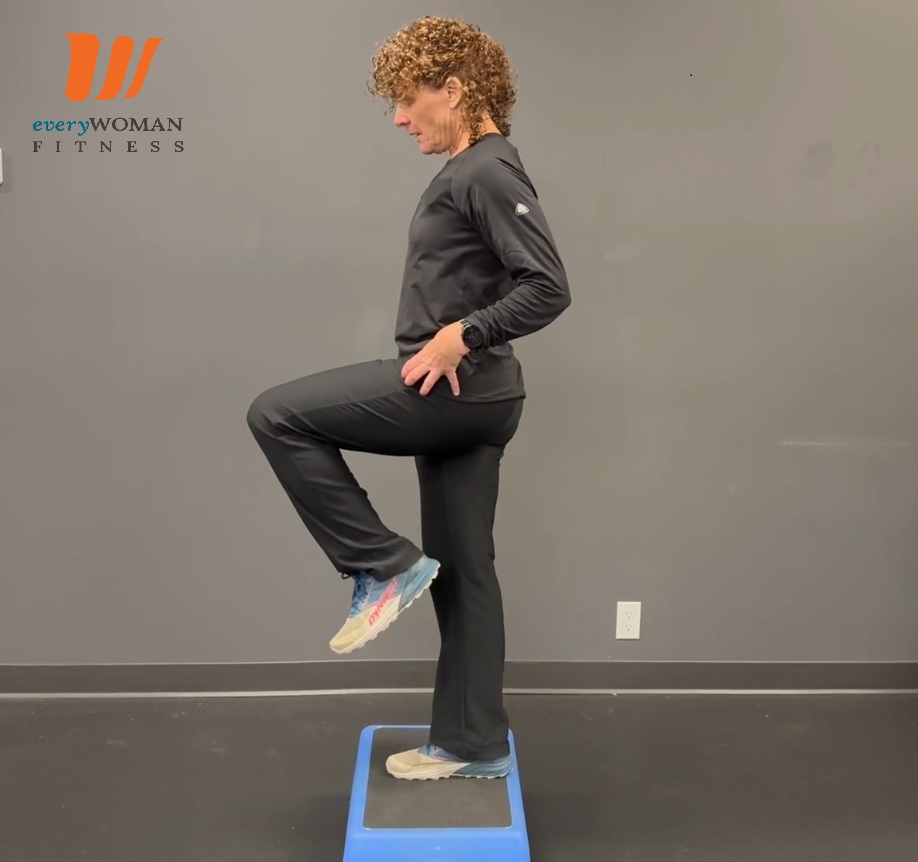
The Humble Step Up
Step-ups are deceptively simple—and that’s their power. Each rep builds targeted strength, balance, and movement confidence while preparing you for real-world tasks. We’re not just training legs—we’re investing in your vibrant mobility for life.
Stronger One Step at a Time
We often train strong with both feet grounded—thank you, squats and deadlifts. But real life doesn’t always demand that. Think about stepping up onto curbs, hiking uneven hills, or reaching into a high cabinet—it’s single-leg strength and balance that save the day. So, right before you start step‑up work in the program, we want to share why this humble move deserves a spotlight.
Why We’re Excited About Step-Ups
Real-Life Ready
Step‑ups train one leg at a time—just like your body does during everyday movement. That’s why they feel so natural, so transferable to daily life. And because they’re intuitive, they’re easier to nail with good form right from the start.Strong Hips, Strong Foundation
Research shows the step‑up (and its variations) activates the gluteus maximus at some of the highest levels across lower-body strength exercises—especially compared to things like squats or lunges. That means more power, more hip strength, better support for your knees and back.Boost in Functional Power
In older women, a home-based, weighted step‑exercise program over six weeks produced a 10–11% improvement in lower-limb power—and even made stair-climbing noticeably easir. That kind of progress is a game-changer for everyday independence.Precision & Focus
Biomechanical analysis in older adults shows that the forward step‑up hones in on hip extensor strength—while the lateral step‑up targets the knees and ankles, giving you options depending on what your body needs most.
Fun Fact
Step‑up movements trace roots back to the 19th century, but the enhanced “Bulgarian Step‑Up” variation actually originated from a Russian hammer‑throw champion turned trainer. This functional, single‑leg variation was developed to strengthen athletes in a way that was easier on the lower back than traditional squats.
How We’ll Ease You In
We’ll kick off with low bodyweight step-ups—no jargon, just confident steps and good alignment. As you get comfortable, you can adjust height, tempo, or added weight to increase the challenge.
SOURCES
https://www.menshealth.com/fitness/a19535190/bulgarian-step-up/?
Neto WK, Soares EG, Vieira TL, Aguiar R, Chola TA, Sampaio VL, Gama EF. Gluteus Maximus Activation during Common Strength and Hypertrophy Exercises: A Systematic Review. J Sports Sci Med. 2020 Feb 24;19(1):195-203. PMID: 32132843; PMCID: PMC7039033.
Mair JL, De Vito G, Boreham CA. Low Volume, Home-Based Weighted Step Exercise Training Can Improve Lower Limb Muscle Power and Functional Ability in Community-Dwelling Older Women. J Clin Med. 2019 Jan 4;8(1):41. doi: 10.3390/jcm8010041. PMID: 30621121; PMCID: PMC6352105.
Wang MY, Flanagan S, Song JE, Greendale GA, Salem GJ. Lower-extremity biomechanics during forward and lateral stepping activities in older adults. Clin Biomech (Bristol). 2003 Mar;18(3):214-21. doi: 10.1016/s0268-0033(02)00204-8. PMID: 12620784; PMCID: PMC3460801.