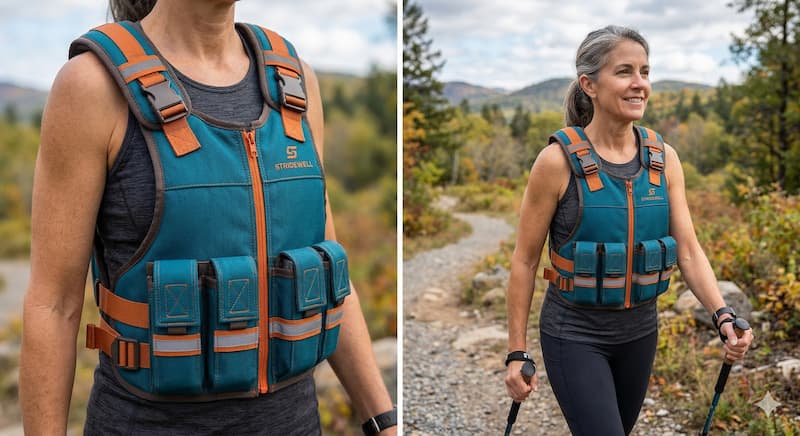
Weighted Vests – Benefits and Blind Spots
In this article we investigate the marketing claims around weighted vests. We highlight the cardiovascular benefits of weighted vests while also explaining the deficits and the science behind why these vests may not build bone strength, especially for women over 50.
Lately we’ve seen an uptick the concept of “rucking” or weighted walking as a way to increase bone health and combat osteoporosis, especially for post-menopausal women. These claims sound appealing and convenient - just add an extra 10 or so pounds to your daily walk and you are combating bone loss.
In this article, we dig into the benefits and blind spots of wearing a weighted vest. While weighted vests can be a great tool for increasing cardiovascular health and maintaining bone density in some areas of the body, weighted walking alone misses the target for common sites for fracture risk in post-menopausal women.
Fun Fact: The term “rucking” originates from military training – building strength and endurance to carry heavy weight over long distances – and comes from the German word der rücken ("the back").
Bone Science 101 – Load with Heavy Enough Weight
The 19th-century German anatomist and surgeon Julius Wolff came up with what is now recognized as a widely accepted principle known as Wolff’s Law: Bone in a healthy person or animal will adapt to the loads under which it is placed. When bone receives stress, it remodels itself.
In 1987 Harold Frost, an American orthopedic surgeon and researcher, added to Wolff’s Law the concept that a minimum amount of pressure needs to be applied for bone growth. Within this concept is a term known as a Dead Zone – where lower loads of weights do not increase bone density. This is why weighted vests in the 10 to 20-pound range are great for bone maintenance but may not provide enough load for bone growth.
Compounding the issue for women over 50 is that the minimum effective load required to stimulate bone growth increases as estrogen declines. Estrogen helps regulate how bone cells respond to mechanical loading and maintain the balance between bone formation and breakdown. After menopause, bone becomes less responsive to lower levels of stress, meaning greater loads are needed to trigger bone-building signals. It may seem unfair, but it is the biological reality that separates the modest loading of weighted walking from the stronger stimulus created by high-intensity strength training.
Site Specific Bone Density – Why Weighted Vests Fail the Upper Body
Another area where the marketing of weighted vests often falls short for women over 50 is the fracture sites of most concern are the hip, spine, and wrist. While a vest is good for leg and hip maintenance and can help with the spine, it does almost nothing for the upper body. In fact, for many women, the first sign of bone loss isn't a hip fracture; it’s a broken wrist from a falling on an outstretched hand.
Upper Body: Wearing a weighted vest pulls the weight down through your spine, hips, and legs, leaving your arms swinging freely. There is no significant mechanical load being placed on your forearm, upper arm, or the delicate bones of the wrist. Loading your upper body with pushups, bench presses, planks and overhead press stimulate upper body bone growth.
The Spine: While a vest provides some vertical compression, it often lacks the rotational or heavy loading required to significantly alter bone density in the thoracic and lumbar spine compared to exercises like Squats or Deadlifts.
The Grip Strength Connection: Grip strength is strongly associated with overall bone mineral density in postmenopausal women. When you squeeze a heavy dumbbell or kettlebell, you are loading the bones of the hand and forearm in a way that walking (even with a vest) cannot replicate.
Summary: Weighted Vest + Full Body Strength Training = Gold!
There are strong arguments for wearing a weighted vest when you walk. It will increase caloric burn and cardiovascular demand. It can also help with bone maintenance for your hips and lower legs. But it falls far short of the needs of peri and post-menopausal women who are seeking to increase their bone health.
Full body strength training 2 – 3 times per week using weight heavier weights (70 – 85% of your one rep max) and fewer reps (5 – 10 reps per set) is proven to be effective in building bone density for women, especially as estrogen levels decline post menopause.
Weighted vest is a fantastic compliment, but it is not a substitute for lifting heavy things.
If you want to protect your future self from fractures, you need to challenge your bones from every angle, not just from the top down.
If you are considering starting a strength training program, take a look at our strength training programs for women over 40. If you are considering an online program, you might want to read our deep dive into online strength training programs marketed to women over 40, as well as programs that are specifically designed for women over 40 strength training at home.
Many choices exists for strength training. The important thing is to pick one and commit to strength training 2 - 3 times per week.
References
Wolff, J. (1892). Das Gesetz der Transformation der Knochen (The Law of Bone Transformation). Berlin: August Hirschwald.
Frost, H. M. (1987). The mechanostat: A proposed pathogenic mechanism of osteoporoses and the bone mass effects of mechanical and nonmechanical agents.
Santos, L., et al. (2017). "The Effects of Resistance Training on Bone Mineral Density in Postmenopausal Women: A Systematic Review and Meta-Analysis." Aging Clinical and Experimental Research.
van Oostwaard M (2018). Osteoporosis and the Nature of Fragility Fracture: An Overview. In: Hertz K, Santy-Tomlinson J, editors. Fragility Fracture Nursing: Holistic Care and Management of the Orthogeriatric Patient [Internet]. Cham (CH): Springer.
Eslamipour F, Gheitasi M, Hovanloo F, Yaghoubitajani Z. (2023). High versus Low-Intensity Resistance Training on Bone Mineral Density and Content Acquisition by Postmenopausal Women with Osteopenia: A Randomized Controlled Trial. Med J Islam Repub Iran.
Cousins, J. M., et al. (2010). "Grip strength and bone mineral density in postmenopausal women." Journal of Clinical Densitometry.
Watson SL, Weeks BK, Weis LJ, Harding AT, Horan SA, Beck BR (2018). High-Intensity Resistance and Impact Training Improves Bone Mineral Density and Physical Function in Postmenopausal Women With Osteopenia and Osteoporosis: The LIFTMOR Randomized Controlled Trial.