Falls in Winter Part III — What Actually Helps Reduce Fall Risk
Strength, balance, and reaction speed play a central role in reducing fall risk. In Part III of this falls series, we explore what actually helps, how tools like traction devices and poles fit in, and when physical therapy support is appropriate. Preparation, not avoidance, builds confidence and resilience.
In Parts I and II of this series, we explored why seasonal changes increases fall risk and what falls and near falls can tell us. In Part III, we turn to what actually helps reduce fall risk over time.
Winter surfaces may be unpredictable, but the body’s ability to respond does not have to be. Fall risk is influenced by trainable physical capacities, smart environmental strategies, and appropriate professional support when needed.
Strength and Balance Matter More Than Avoidance
The strongest predictors of fall risk are not slippery surfaces alone, but how well the body can respond when balance is challenged.
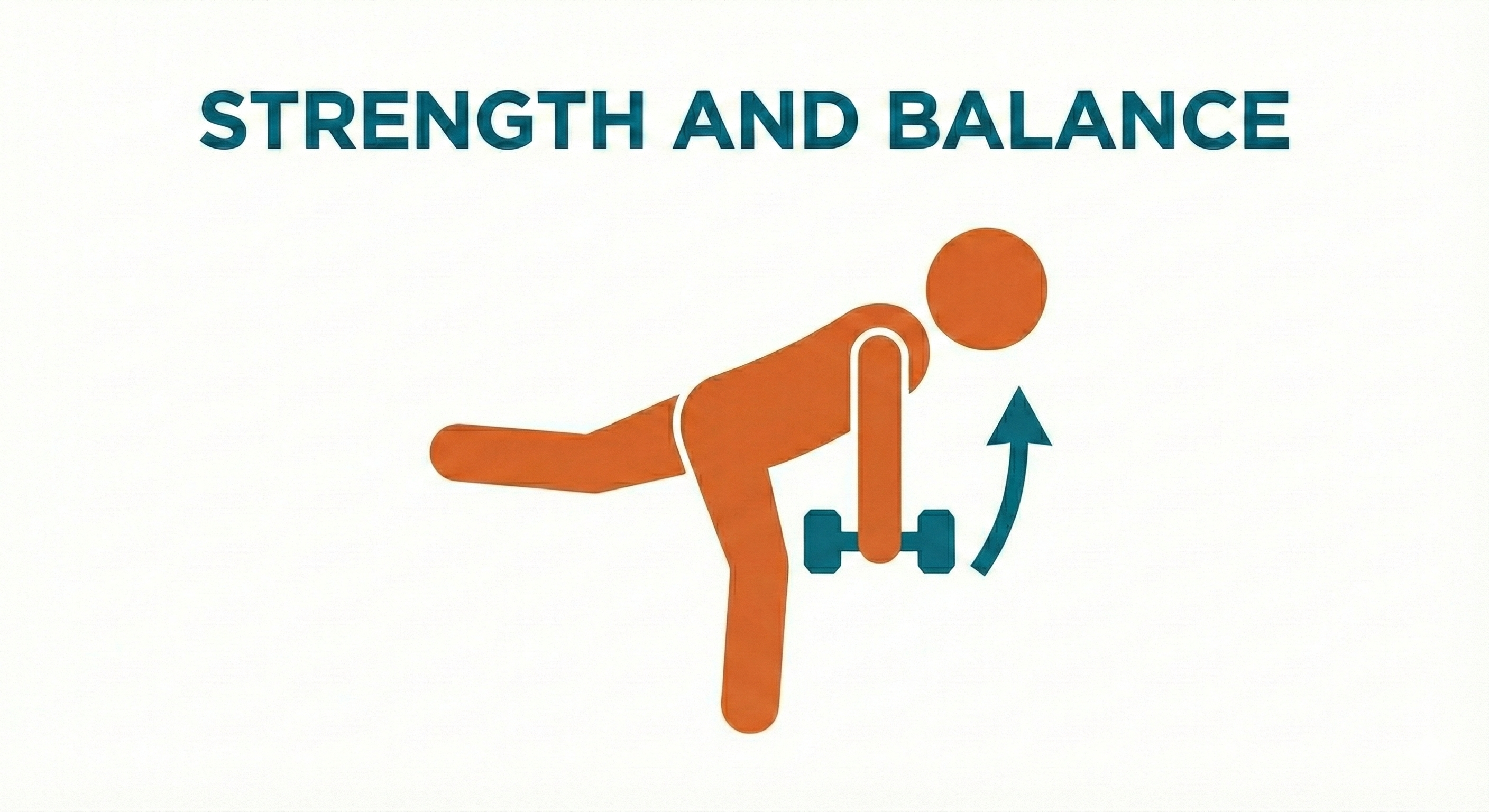
Research consistently shows that improving physical capacity reduces fall risk. Lower-body strength, single-leg stability, lateral control, and trunk strength all contribute to balance recovery when a slip or misstep occurs.
Avoidance strategies such as sticking only to flat surfaces or limiting movement may feel protective in the short term, but they do not build the capacity needed for long-term confidence or resilience.
Power and Reaction Speed Are Often the Missing Link
Strength is necessary, but it is not sufficient.
Many falls happen too quickly for slow strength alone to help. The body must react, produce force, and stabilize within fractions of a second. Muscle power and reaction speed play a critical role in successful balance recovery.
Training that includes controlled, progressive challenges to speed, direction change, and balance recovery helps prepare the nervous system for real-world demands. This does not mean reckless movement. It means appropriate progression, good technique, and exposure to challenge that builds confidence rather than fear.
Environmental Tools Can Help, But They Are Not a Substitute
Environmental strategies can reduce risk, particularly during winter months.
Over-the-shoe traction devices such as NanoSpikes or YakTrax can improve grip on icy or packed surfaces. Trekking or walking poles provide additional points of contact and may improve stability during winter walks or hikes.
These tools are supports, not solutions on their own. They work best when paired with training that improves the body’s ability to respond when balance is disrupted.
When Physical Therapy Plays a Key Role
Some aspects of fall risk are best addressed through individualized clinical care.
Physical therapists are trained to assess balance, gait, reaction time, strength, and movement strategies. For individuals with a history of falls, repeated near falls, or complex risk factors, PT can provide targeted guidance and progression that generalized fitness programming cannot.
An important and evolving area within physical therapy is fall-response training. For select individuals, learning how to respond during a fall may help reduce injury risk. This can include strategies to protect the wrists, head, and spine, improve reaction timing, and reduce panic during sudden loss of balance.
This type of training should be guided by a qualified physical therapist. It is not appropriate for unsupervised practice or generalized fitness programming.
Where Every Woman Fitness Fits
Our strength programming focuses on the trainable foundations that support long-term fall risk reduction.
Our programming builds strength, balance, lateral control, reaction capacity, and confidence through progressive challenge. Women who are at a high risk of falling benefit most by combining physical therapy guidance with ongoing strength and balance training.
If you are working with a physical therapist, you can share our strength program and ask how to best integrate it alongside your home exercise program.
The Takeaway
Falls are not inevitable. They are influenced by physical capacity, confidence, and preparation.
Strength, balance, and reaction speed matter. Environmental tools can help. Professional support has an important role when needed.
Preparation builds confidence. Confidence supports movement. Movement supports resilience.
References
Sherrington C, et al. Exercise to prevent falls in older adults. British Journal of Sports Medicine. 2017;51(24):1750–1758.
https://bjsm.bmj.com/content/51/24/1750Montero-Odasso M, et al. Falls prevention in older adults. The Lancet. 2021;397(10288):1627–1640.
https://www.sciencedirect.com/science/article/pii/S0140673621002389Mansfield A, et al. Does perturbation-based balance training prevent falls? Physical Therapy. 2015;95(5):700–709.
https://academic.oup.com/ptj/article/95/5/700/2686494Sherrington C, et al. Effective exercise for the prevention of falls. Journal of the American Geriatrics Society. 2020;68(5):977–985.
https://agsjournals.onlinelibrary.wiley.com/doi/10.1111/jgs.16342