Falls Part II — What Near Falls Tell Us and When to Seek Help
Near falls are not random or harmless. In Part II of this series, we explore why near falls predict future falls, how fear can increase risk, and when it is appropriate to seek support from a physical therapist or primary care provider, alongside ongoing strength and balance training.
In Part II, we turn to what falls and near falls actually tell us, and how to know when it is time to seek additional support.
Falls are not random events. They are signals. Learning to interpret them early can help reduce risk and prevent more serious injury.
What Counts as a Near Fall
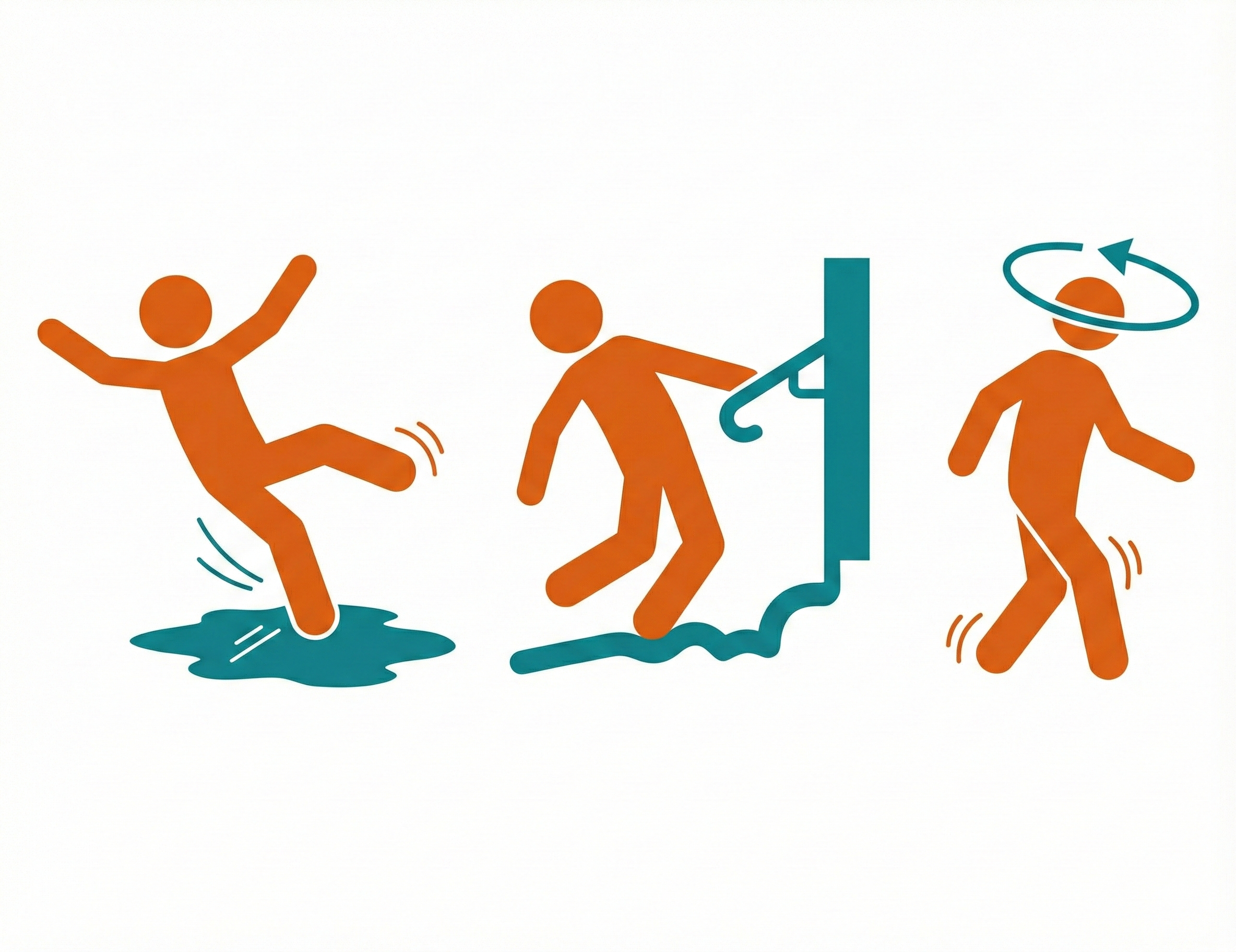
Near falls often go unreported because no one ends up on the ground. But they matter.
Examples include:
Slipping but catching yourself
Grabbing a railing or wall to stay upright
Stumbling on uneven ground
Feeling momentarily out of control while walking or turning
Having to take several quick steps to recover balance
These events indicate that balance recovery was challenged, even if it was ultimately successful.
Why Near Falls Matter
Near falls are not trivial. Research consistently shows that falls predict future falls, and near falls often precede them. They provide early information about how well the body can respond to unexpected challenges.
A near fall may reflect:
Delayed reaction time
Reduced single-leg strength
Limited lateral stability
Decreased muscle power
Changes in vision, including depth perception or low-light vision
Hesitation or guarded movement
Ignoring near falls means missing an opportunity to intervene before a more serious event occurs.
Fear After a Fall Can Increase Risk
After a fall or near fall, many people naturally change how they move. Activity levels drop. Uneven surfaces are avoided. Movements become smaller and stiffer.
While understandable, this response can unintentionally increase fall risk. Reduced movement leads to further loss of strength, balance, and confidence. Over time, the body becomes less prepared to handle the very challenges it is trying to avoid.
Confidence does not return through caution alone. It returns through capability.
When to Seek Professional Support
Our strength programming support long-term strength, balance, and confidence. There are also situations where individual clinical assessment is appropriate and important.
Consider seeing a physical therapist and or your primary care provider if you have experienced:
A recent fall during normal daily activities
Repeated near falls
Falls without a clear external cause
Fear of falling that is changing how you move
Difficulty recovering balance when bumped or slipping
Vision changes, especially depth perception or night vision
New dizziness, weakness, or asymmetry
Falls combined with known bone loss
A physical therapist can assess balance, gait, strength, reaction time, and fall risk using standardized tools and observation, then help determine what needs targeted attention.
A Note on Learning How to Fall
This is an area of growing recognition in physical therapy.
People with a history of falls are more likely to fall again. For some individuals, learning how to respond during a fall may help reduce injury risk. This can include practicing safe descent strategies, improving reaction timing, and learning how to protect the wrists, head, and spine during an unexpected loss of balance.
This type of training should be guided by a trained physical therapist. It is not appropriate for unsupervised home practice or generalized fitness programming.
Our programming does not teach falling techniques. Instead, we encourage referral to physical therapists who are trained to assess risk and safely introduce fall-response strategies when appropriate.
Where Every Woman Fitness Fits
Our strength programs address modifiable contributors that influence fall risk over time, including strength, balance, lateral control, reaction speed, and confidence built through progressive challenge.
Many women benefit most by combining physical therapy guidance with ongoing strength and balance training. If you are working with a physical therapist, you can share our programming and ask how to best integrate it alongside your home exercise program.
Next, in Part III of this series, we will focus on what actually helps reduce fall risk long-term, including training strategies, environmental tools, and confidence-building approaches that support safe, capable movement through winter and beyond.
References
Rubenstein LZ. Falls in older people: epidemiology, risk factors and strategies for prevention. Age and Ageing. 2006;35(Suppl 2):ii37–ii41.
https://academic.oup.com/ageing/article/35/suppl_2/ii37/40797Ganz DA, et al. Will my patient fall? JAMA. 2007;297(1):77–86.
https://jamanetwork.com/journals/jama/fullarticle/205826Montero-Odasso M, et al. Falls prevention in older adults. The Lancet. 2021;397(10288):1627–1640.
https://www.sciencedirect.com/science/article/pii/S0140673621002389Mansfield A, et al. Does perturbation-based balance training prevent falls? Physical Therapy. 2015;95(5):700–709.
https://academic.oup.com/ptj/article/95/5/700/2686494