When Exercise Plans Need to Change
Injury, illness, travel, and life's unexpected detours can disrupt even the best exercise plans. Learn why adapting your workouts, trying new activities, or taking time to recover can support your long-term health and fitness goals.
Making room for the unexpected without losing sight of your goals
Even the best exercise plan occasionally needs adjusting. Illness, injury, work demands, travel, and the ordinary unpredictability of life can interfere with our carefully planned workouts. Sometimes we miss a session, sometimes we modify an exercise, and sometimes we put an entire training block on hold.
That's normal. A good exercise program provides structure and direction, but it should also leave room for flexibility.
A Troubled Bridge Over Water
A few days ago, while running across a small bridge on a local trail, I caught a toe and fell, fracturing my left ring finger. Lying on the wooden slats, cradling my injured hand, I swore at the bridge for tripping me. As I collected my dogs and began running home, my aching wrist and hand told me this fall was going to cost me.
The timing was particularly inconvenient. My Monday lifting partners and I had just started a six-week training block involving exercises requiring substantial demands on the hands. I'd been looking forward to improving my skills in these dynamic, fun movements.
I very much want to continue training with my friends. These workouts offer more than physical conditioning. They're opportunities to learn new skills, challenge ourselves, and enjoy time together. But improperly loading my injured finger could turn an uncomplicated fracture into something far worse. The risk-reward calculation isn't particularly difficult, even if accepting the answer is.
Learning to respect my body rather than thoughtlessly pushing forward remains a work in progress. The one good thing I've found in this bridge incident is that it inspired this article. My legs are perfectly healthy, allowing me to continue running, and I'm enjoying putting my PT training to work finding safe adaptations for my usual strength exercises.
Between decades of athletic pursuits and more than a quarter-century of physical therapy practice, I've learned that changes to planned workouts are rarely catastrophic. Placing a workout plan above common sense, however, can be.
When Illness Changes the Plan
Illness presents a different challenge. Unlike a localized injury, illness may affect the entire body, making rest an indispensable part of recovery.
We exercise to improve our health, physical capacity, and quality of life, not simply to accumulate workouts. If our larger goal is to extend our healthspan, then sometimes choosing not to exercise is precisely the decision that best supports that goal. A mild illness may allow for gentle activity, while fever, significant fatigue, chest symptoms, or other systemic symptoms call for greater caution. More significant illnesses may require medical guidance and a gradual return to training.
Sometimes rest is the most productive way to pursue our health goals.
When One Body Part Needs a Break
An injury doesn't always require the rest of the body to stop training. It may simply require a different approach. An upper-extremity injury may leave walking, spinning, and lower-body strength training available. A lower-extremity injury might offer an opportunity to emphasize upper-body or core strength, or inspire creative ways to maintain cardiovascular fitness.
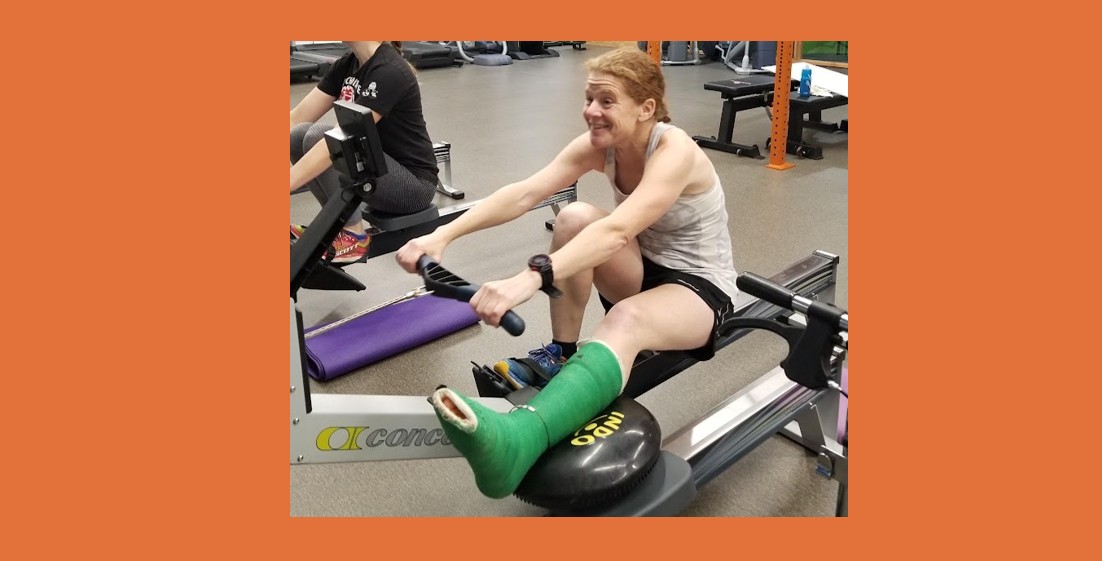
One of my favorite tools for working around lower-body injuries is the old Schwinn Airdyne, an air-resistance bike with moving handlebars. I've spent many hours driving one with both arms and a single leg, resting the injured leg on a stationary foot peg. I've also improvised with rowing machines, positioning a second rower alongside the first so an injured leg could rest on its sliding seat, moving without contributing to the rowing effort.
These are adaptations I've personally used, not prescriptions for particular injuries. Even apparently unloaded tissues may experience forces or movements that interfere with recovery. Understanding what the injured structures can safely tolerate, ideally with appropriate professional guidance, must come first. Once we know the boundaries, creativity can be useful.
When Life Offers a Different Training Block
Not every change comes from something unpleasant. Vacations, seasonal activities, and changes in routine can offer opportunities to move differently. A vacation might replace regular strength workouts with hiking, swimming, cycling, or long days exploring a new city. Winter brings skiing, while summer might offer gardening, paddling, or mountain biking. These activities challenge our bodies in ways our usual workouts may not.
At Every Woman Fitness, we deliberately vary training demands to develop strength, power, endurance, and other physical capacities. Different activities provide different stimuli, and those differences can be valuable. A week spent hiking instead of lifting isn't the same training stimulus as a week in the gym. Nor is it necessarily an inferior one. It's simply different.
Of course, unfamiliar activities deserve some restraint. Being strong and fit doesn't mean every tissue is prepared for an entirely new loading pattern. Preparation, or at least a gradual introduction to new demands, can make the transition more manageable. This is part of the thinking behind EWF programs such as Take the Slope and Resilient Runner, which help prepare participants for the particular demands of skiing and running.
The Bigger Picture
Training challenges our bodies, and recovery allows us to adapt to those challenges. Planned periods of reduced training, often called deloads, are a useful part of all good exercise programs. While an unexpected interruption isn't necessarily the same as a planned recovery period, a few missed workouts generally won't undo months or years of training.
And not every missed workout needs to be made up.
Injury, illness, and life's other surprises are inevitable. Sometimes the appropriate response is to modify an exercise, explore a different activity, or temporarily step away from training altogether. None of these choices means abandoning our larger goals. The important distinction is between the plan and the purpose behind it. Our workouts are tools for building strength, health, and physical capacity. They aren't ends in themselves.
A successful exercise program isn't one we follow perfectly regardless of circumstances. It's one that helps us pursue better health over the long term, even when life requires us to change course. And sometimes, the unexpected detour introduces us to something worth keeping long after our original plans are back on track.