Why Eccentric Strength Training is Important for Peri- and Post-Menopausal Women
In this article we define what an eccentric contraction is during strength training, detail why it's important for peri-post menopausal women, and give examples of eccentric strength movements that you will find in our programs. I also share my personal journey to embracing eccentric loading while strength training.
As you are navigating menopausal years, one specific phase of lifting, specifically the eccentric phase, deserves your full attention. In this article we describe the phases of muscle contraction, discuss the benefits to menopausal women of focusing on the eccentric phase, and give you examples of how to implement eccentric loading during your workouts. But first, I start with my own story and how I came to understanding - then feeling - the benefits of focusing on the eccentric phase of strength training.
A Discovery Near the Arctic Circle
I didn't really appreciate the power of eccentrically loading a muscle or tendon until a decade or so ago when I was, oddly enough, in a small town just shy of the Arctic Circle sitting across the desk from Dr. Håkan Alfredson. I was one of many competitive athletes who made the trek up to Umeå, Sweden, seeking the surgical skill of Dr. Alfredson to address my painful Achilles. A big angry bump at the back of my heel announced itself with every step, making it hard to wear anything but open heel shoes, much less run.
After doing an ultrasound and confirming surgery was necessary, (stating, "It's not a matter of if your tendon ruptures, it's a matter of when"), our conversation fast-forwarded to post op recovery protocols. Unlike the approach in the States, Alfredson's protocol had me in a sock and on crutches (preferably just one crutch after the first day) for 1 to 2 weeks, and soon thereafter, slow and controlled heel drops to eccentrically load the Achilles tendon and muscles below the knee. He explained his research showed that eccentric loading stimulates muscles and tendon to add new fibers so that the end range of motion increases post-surgery. It worked.
After years of yoga and stretching, my hands still dangled above my toes in a forward fold. Understanding from Dr. Alfredson that eccentrically loading an area of the body could increase range of motion, I started doing this with squats and deadlifts. Once I started focusing on the eccentric phase of lifting, I could comfortably touch my toes in a forward fold. My hamstrings and hips felt far more open and resilient.
Eccentric loading can be applied to any compound lifting movement. Below is a breakdown of what eccentric contractions are, why they are incredibly beneficial during the menopausal transition, and how to incorporate them into your routine.
What is an Eccentric Contraction?
Every time you lift a weight, your muscles go through three distinct phases of contraction:
Concentric: The muscle shortens as it contracts (e.g., pulling the weight up during a bicep curl).
Isometric: The muscle flexes without changing length (e.g., holding a plank position).
Eccentric: The muscle lengthens while under tension (e.g., slowly lowering the weight back down during a bicep curl).
Often referred to as the "negative" phase of a lift, the eccentric contraction acts as a braking mechanism. Bio-mechanically, your muscles can produce and handle significantly more force during the eccentric phase than during the concentric phase, sometimes upwards of 20% more.
Why Eccentric Training Benefits Peri- and Post-Menopausal Women
The transition through menopause brings significant physical changes, primarily driven by a decline in estrogen. This hormonal shift accelerates the loss of both bone mineral density, which increases the risk of osteopenia and osteoporosis and lean muscle mass (a condition known as sarcopenia). Nikki has written a three part series, starting with Bone Loss: Understanding Osteoporosis.
The scientific data clearly shows that maintaining muscle mass and bone strength is critical for longevity and independence in aging women, which we explain in our article The Benefits of Strength Training With Weights. Focusing on the eccentric phase of strength training offers a unique, highly effective countermeasure to these declines.
1. Superior Mechanical Loading for Bone Health Bones adapt and grow denser in response to the physical stress placed upon them. Because you can handle heavier weight and maintain longer periods of tension during eccentric contractions, the mechanical load applied to your skeletal system is greater. This high-tension environment is a powerful stimulus for bone remodeling, helping to stave off age-related bone loss.
2. Increased Mobility and Flexibility As estrogen levels decline, many women experience increased joint stiffness and a loss of flexibility. While stretching is the traditional go-to, eccentric loading is scientifically proven to improve range of motion, which matches with my personal experience. Lowering a weight under control stimulates your body to add new muscle fibers, structurally lengthening them. The result is greater flexibility and mobility.
3. Enhancing Connective Tissue Resiliency As estrogen drops, tendons and ligaments can lose some of their natural elasticity. Eccentric training places a deep, controlled stretch on the muscle and its connective tissues. This promotes better stability and dynamic balance.
Examples of Eccentric-Focused Movements
To reap the benefits of eccentric contractions, you don't need to add new exercises; you just need to change the tempo of the ones you already do. By slowing down the lowering phase of compound movements (exercises that work multiple joints and muscle groups at once), you maximize the eccentric load.
1. The Deadlift (video)
The Eccentric Focus: The entire downward movement is the eccentric phase for your hamstrings and glutes. Lower the weight on a slow, 3- to 4-second count until you feel a deep stretch in the backs of your legs. Squeeze your glutes and stand back up at a normal speed.
Benefits: Deadlifts load the posterior chain (the muscles along the back of your body), supporting pelvic stability, posture, and hip joint strength.
2. The Squat (video)
The Eccentric Focus: The descent into the squat is the eccentric phase. Take 4 to 5 seconds to slowly lower yourself to the bottom of the squat, maintaining control and tension in your core and legs. Drive back up to the standing position.
Benefits: This builds exceptional quad and glute strength while heavily stimulating the femur (thigh bone) and hips to build bone density.
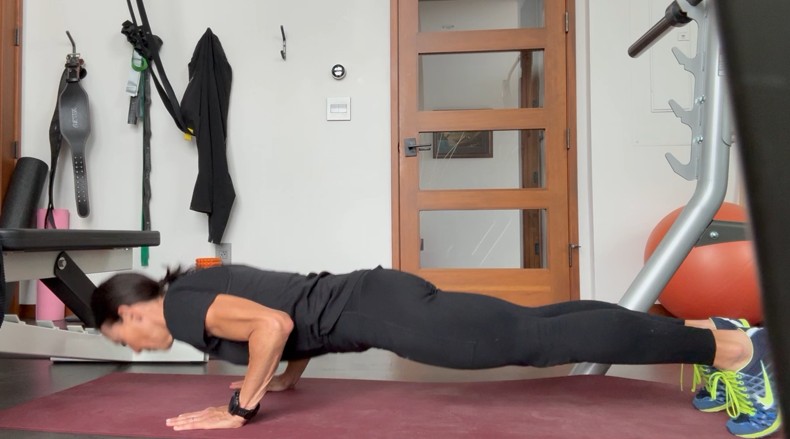
3. The Push-up (video)
The Eccentric Focus: Slowly lower your entire body to the floor as one solid unit, taking 4 to 5 full seconds to get your chest to the ground. If you don't have the strength to push back up, simply drop your knees, push yourself back to the top plank position, and repeat the slow lowering phase.
Benefits: This is a great way to build foundational upper body and core strength, safely loading the wrists, elbows, and shoulders.
The Take Away
As mentioned, I've found that focusing on slowing the eccentric phase, particularly during squats and deadlifts, my hips and hamstrings are noticeably more flexible and resilient. I can catch a toe on a trail, take a hard stumble or fall, and not feel the effects, other than to my ego.
You don't need to add new exercises - you just need to focus on slowing down during the eccentric phase of each strength movement. Give it a try In your next workout. After a month or so, let us know if you feel the difference.
References
van der Plas A, de Jonge S, de Vos RJ, van der Heide HJ, Verhaar JA, Weir A, Tol JL. A 5-year follow-up study of Alfredson's heel-drop exercise programme in chronic midportion Achilles tendinopathy. Br J Sports Med. 2012 Mar;46(3):214-8. doi: 10.1136/bjsports-2011-090035. Epub 2011 Nov 10. PMID: 22075719; PMCID: PMC3277725.
Marcus, R. L., LaStayo, P. C., Dibble, L. E., Hill, L., & McClain, D. A. (2009). Increased Strength and Physical Performance with Eccentric Training in Women with Impaired Glucose Tolerance: A Pilot Study. Journal of Women's Health, 18, 253-260.
O'Sullivan, K., McAuliffe, S., & DeBurca, N. (2012). The effects of eccentric training on lower limb flexibility: a systematic review. British Journal of Sports Medicine, 46(12), 838-845.