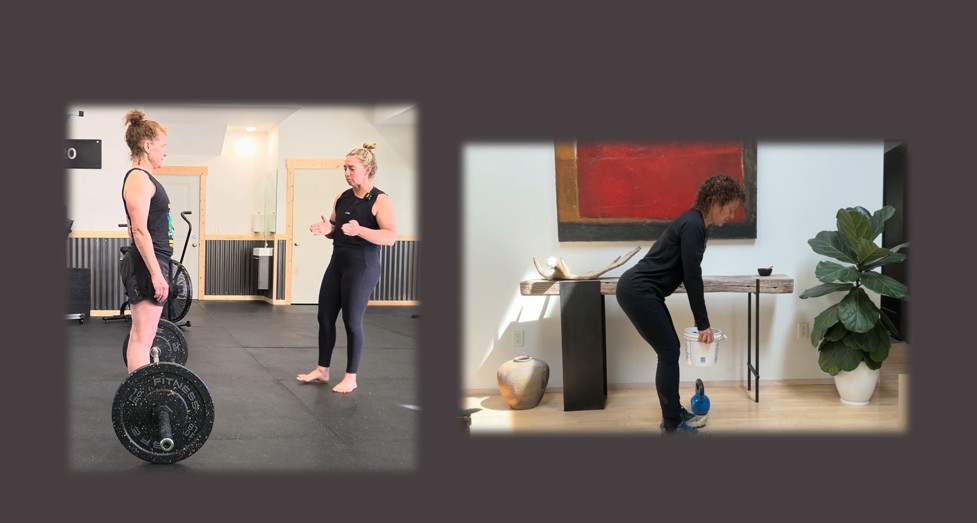
Online vs. In-Person Strength Training for Women Over 40: What Actually Works?
If you're a woman over 40 navigating menopause, a full schedule, and a body that recovers differently than it used to - the online-vs-in-person strength training question deserves investigation. This article outlines the questions and considerations to help you make an informed decision.
If you're a woman in your 40s, 50s, or 60s weighing whether to hire a local personal trainer or commit to an online strength program, you're asking exactly the right question. The answer isn't simply one or the other. It depends on what your body actually needs at this life stage, and whether the program you choose was built with that in mind.
Here's what we know from over two decades of combined experience in orthopedic physical therapy, elite athletics, and coaching women in their 40's, 50's and beyond.
The Question Most Women Are Actually Asking
When women over 40 come to us, they're rarely asking "online or in-person?" in the abstract. They're asking something more specific:
"Is it safe to lift heavy at home without someone watching my form?"
"Can I really make progress without a trainer holding me accountable?"
"Will a generic online program actually account for my hormones, my recovery, my life?"
Those are the right questions. Let's answer them directly.
What the Menopause Transition Actually Does to Your Training Needs
Before comparing delivery formats, it helps to understand what's happening physiologically because it changes everything about how a program should be designed.
During the menopause transition, declining estrogen accelerates the loss of both bone mineral density and lean muscle mass. Learn more about understanding bone loss as it relates to hormonal changes. Recovery between sessions takes longer. Connective tissue loses some of its natural elasticity.
The training approach that helps a 25-year-old athlete chase the edge is not identical to the approach that helps a 52-year-old build a body meant to thrive over the next 25 years. Different goals, different physiology, and different stages of life require different strategies. That is not weakness. It is physiology. Read Nikki's personal take on the need to recalibrate expectations after 40.
This matters enormously when evaluating any training option, be it online or in-person, because most programs, regardless of format, were not designed with midlife female physiology in mind.
The Case for In-Person Personal Training (and when to consult a Physical Therapist)
In-person training has real, legitimate strengths. A skilled trainer can:
Watch your movement in real time and correct form errors immediately
Provide tactile cueing adjusting posture or positioning physically
Create accountability through a scheduled appointment and a person waiting for you
Adapt the session on the spot based on how you're feeling that day
For women who are completely new to resistance training, have a specific injury history, or struggle with motivation, in-person training can be a strong starting point.
The honest trade-offs, however, are significant:
Cost: Quality personal training typically runs $80–$150+ per session. For the two to three sessions per week that evidence supports for postmenopausal women, that's $640–$1,800 per month.
Specialization: Many personal trainers are generalists. Finding one who is specifically trained in perimenopausal and postmenopausal physiology, bone density programming, and midlife recovery demands is important.
Schedule dependency: You train when and where your trainer is available, not when your time, energy and recovery windows align.
Longevity: The goal for women over 40 isn't a 12-week transformation. It is about building a sustainable habit for the next 20 to 30 years. Costs over the long run can be a factor.
If you are new to strength training and want in-person feedback, consider hiring a personal trainer for a few sessions, then switching to a less expensive option.
If you have an injury, osteoporosis, or other condition affecting your body and movement, we strongly recommend seeing a physical therapist who can help you safely start strength training.
The Case for Online Strength Training
Many choices exist for online fitness. We've done a couple of deep dives into apps that are marketed to women over 40, and discovered that too many are really targeting a younger population and are not specific to the needs of menopausal women.
What a well designed online program takes into account:
Peri-post menopause awareness: Does the program acknowledge the unique needs of women with hormonal shifts and adjust training to target areas of risk, such as bone health?
Home-friendly design: Can you do it without a gym membership or expensive equipment?
Efficiency and effectiveness: Are workouts built around compound movements and progressive overload, in order to attain the most benefit in the time available to a busy person?
Strength focus: Cardio and high intensity alone won't cut it. Muscle strength and bone health matters more than ever after 40.
Accessibility and community: Is the price point realistic? Do you feel seen by the program?
Read our detailed assessment of Strength Training Apps for Women Over 40, and our assessment of the Best at Home Workout Programs for Women Over 40.
For women navigating menopause, the structure and consistency of a well-designed online strength program can be just as effective as working with an in-person trainer, and often more sustainable because it fits around real life.
The key phrase is well-designed. Not all online programs are created equal. For women over 40, the difference between a program built for midlife physiology and one retrofitted from a mass-market template is not cosmetic. It is functional.
What a well-designed online program delivers:
Periodized progressive overload, not random daily workouts: Structured movement progression builds on itself week over week, delivering the mechanical load needed to stimulate bone remodeling.
Recovery-aware scheduling: Evidence supports two to three sessions per week for postmenopausal women, with at least 48 hours between sessions; a well-designed program builds this in rather than leaving it to chance.
Movement quality instruction: Detailed video guidance with form cues and easier/harder alternatives replaces the need for a trainer to be physically present,
Flexibility without compromise: You train on your schedule, at your energy level, from your home.
Offering two to three highly efficient, 30-minute workouts per week balances the physiological need for heavy lifting with the increased recovery demands of menopause.
The Accountability Question
This is where in-person training often wins the argument - and it's a fair point. A prepaid session with a trainer expecting you at 7am is a powerful motivator.
But accountability in online training is more nuanced than it's given credit for. The women who succeed with online programs tend to share a common trait: they've stopped needing external accountability because the program itself has become a habit. Two to three structured sessions per week, scheduled around their life, with visible progress tracked week over week offers its own form of accountability.
"I appreciate this program because I can go at my own pace, in the comfort of my own home," says Julie, an Every Woman Fitness member. "I'm definitely feeling stronger — and I'm standing up straighter and moving more each day," adds Ellen, another member.
The accountability structure that works is the one you'll actually maintain for years, not months.
Safety Considerations: Can You Lift Heavy at Home Without Direct Supervision?
For many healthy adults, yes. A well-designed strength program can be an effective way to build strength at home when it includes clear instruction, appropriate progression, and guidance on how hard to work. Like any exercise program, however, strength training carries some risk, and no program can eliminate that risk entirely.*
The critical variables are:
Form guidance must be built in.
Step-by-step video instruction with clear movement cues and appropriate exercise modifications helps participants learn sound movement patterns before adding weight. While videos cannot provide real-time feedback, high-quality instruction can help people build confidence and good technique as they progress.
Effort calibration must be explicit.
Women over 40 do not need to train to failure to become stronger. Most sets should feel challenging while still leaving one or two good repetitions in reserve. A well-designed program makes this practical and easy to understand.
Progressive loading must be structured.
Random exercise combinations, even when generated by AI, are unlikely to provide the progressive mechanical loading needed to build strength, muscle, and bone. Well-designed programs follow a logical progression that reflects how the body actually adapts.
The programmer should understand midlife physiology.
Programming for women over 40 should reflect the physiological changes that accompany aging, including recovery, bone health, muscle mass, and connective tissue. Experience matters. Programs thoughtfully designed for this stage of life are different from generic programs created for the general population.
As co-founder Nikki Kimball, an orthopedic physical therapist with more than 25 years of clinical experience, says:
"Every form cue and exercise progression in our programs reflects decades of treating orthopedic patients, coaching athletes, and studying the science of healthy aging. Our goal is to help women become stronger, more capable, and more resilient for the long term."
*Every Woman Fitness programs are intended for generally healthy adults. Strength training, like all physical activity, carries some risk of injury. If you have a medical condition, recent surgery, or concerns about beginning an exercise program, consult your physician or another qualified healthcare professional before participating.
What to Look for in either an Online Strength Program or a Local Trainer
Whether you're evaluating an online program or interviewing a personal trainer, ask the same five questions:
Q: Is this designed for my life stage?
What to look for: Explicit perimenopause/postmenopause awareness, not a generic "over 40" label.
Q: Who designed the programming?
What to look for: Credentialed experts in women's health, not an algorithm or a generalist trainer.
Q. Does it account for recovery?
What to look for: 48+ hours between sessions, periodized loading, no glorification of overtraining.
Q. Is progressive overload built in?
What to look for: Structured advancement week over week, not random daily variety
Q. Is it sustainable long-term?
What to look for: Cost, schedule, and format you can maintain for years, not just a 12-week sprint.
A local trainer can absolutely meet these criteria if they have specific training in midlife female physiology. An online program can absolutely meet these criteria if it was built by people who do.
The Bottom Line
In-person personal training and online strength programming are not inherently in competition. The better question is: was this program, regardless of format, actually designed for a woman navigating menopause?
Most weren't. The fitness industry was built around younger bodies, and most of its products reflect that.
We built Every Woman Fitness specifically because we evaluated the landscape of fitness apps and realized a critical gap existed: little of the programming on the market was actually designed for the physiological realities of midlife women seeking to gain functional strength and increase bone density. We built the solution we couldn't find.
For women who want an accessible, evidence-based, home-friendly option built entirely around the demands of midlife female physiology - Every Woman Fitness is a program that should be strongly considered.