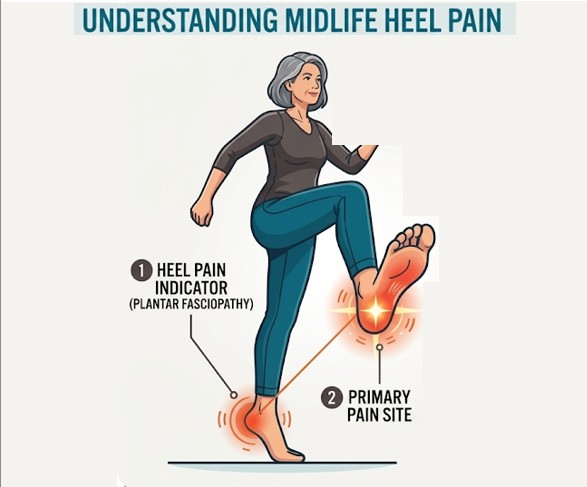
Plantar Fasciopathy in Midlife: What Peri- and Post-Menopausal Women Should Know
Heel pain is common in midlife women. Here’s what helps plantar fasciopathy and why menopause may influence tissue response.
Plantar Fasciopathy in Midlife
Plantar fasciopathy, commonly known as plantar fasciitis, is one of the most common causes of heel pain. The older term ‘fasciitis’ suggests inflammation, but most long-standing cases reflect the actual tissue adaption following repeated loading and irritation rather than a purely inflammatory condition.
It often appears between the ages of 40 and 60—right when many women are moving through peri- and postmenopause. That overlap does not mean menopause causes plantar heel pain, but it does raise a useful question: does hormonal change influence how this tissue responds to load, recovers, and produces pain?
The answer is likely yes—but not in a simple or isolated way.¹
Why Menopause Might Matter
The plantar fascia is connective tissue, and connective tissue responds to hormonal signals.
Estrogen receptors are present in tendon and fascial tissue, and estrogen appears to influence collagen production, tissue remodeling, and how structures respond to loading.² ³ In lower-estrogen states, tissue may become less resilient and more reactive to stress, particularly when combined with mechanical load.
At the same time, menopause brings broader system-wide changes that affect pain and recovery:
· Changes in sleep quality
· Shifts in mood and stress
· Alterations in body composition
· Low-grade systemic inflammation
These factors do not act in isolation. They shape how load is tolerated and how symptoms are experienced.
This is where it is important to stay grounded in the evidence. We do not yet have strong human evidence clarifying the role of midlife hormonal changes in plantar fasciopathy. Hormone therapy is not currently a primary treatment for this condition, in part because it has not been well studied in this context. What we do have is a growing understanding that the hormonal environment can influence connective tissue behavior and pain sensitivity.⁴
What Actually Helps
Plantar fasciopathy is generally treatable, but it responds best to a combination of strategies rather than a single fix.
Stretching, particularly when it targets both the plantar fascia and the calf. Plantar fascia specific stretching appears to provide slightly greater benefit than calf stretching alone. Strengthening matters just as much. Current clinical guidelines support resistance training for the foot, ankle, and calf. This is not just about getting stronger. It is about improving how the tissue handles load. Manual therapy can reduce pain and improve mobility, especially when combined with active treatment. It works best as part of a plan, not as the plan. Taping and orthoses can provide short-term relief. Prefabricated orthoses are often as effective as custom devices and far more cost-effective. Night splints may be useful in more persistent cases, particularly for morning pain, though they are not universally effective. More invasive treatments, including injections and other procedures, tend to provide short-term relief at best and are typically reserved for cases that do not respond to well-executed conservative care.
Each of these approaches works in its own way to influence how load is distributed and tolerated. Across them, the goal is the same: give the tissue an amount of load it can tolerate and adapt to.
How This Shows Up in Real Life
Plantar fasciopathy rarely starts with a clear injury. More often, it shows up gradually in ways that are easy to dismiss at first. A runner or run-walker may notice stiffness or sharpness under the heel at the start of a run that improves as the body warms up, only to return later that day or the next morning. A walker, hiker, or traveler may feel it after a longer day on their feet, or with those first steps out of bed. For others, it builds through accumulation. More time standing than usual. Several days in a row with higher activity. A change in footwear, terrain, or routine. Nothing dramatic, but enough to tip the balance.
In midlife, this pattern can feel more confusing. Activity may look the same on paper, but the response is different. Recovery takes longer. Stiffness lingers. The same inputs no longer produce the same outputs. This is where menopause may be part of the picture, not as a single cause, but as a factor influencing how the system responds to load, stress, and recovery.
Across all of these scenarios, the common thread is not solely damage. It is capacity. The tissue is being asked to handle more than it is currently prepared for. That is why the answer is not to stop moving, but to adjust how load is applied and rebuild tolerance over time.
For many women, that process includes a shift in focus. Not just stretching or symptom relief, but improving how force is managed with each step. The calf plays a major role here, but so does the foot itself. The foot is not passive. It is an active system that helps absorb and transfer load. When it is not contributing effectively, stress is redistributed elsewhere, including the plantar fascia. An experienced foot/ankle or sports physical therapist can work wonders here.
This is where foot-specific strength work begins to matter. Not as a separate add-on, but as part of a broader strategy to improve how the entire lower leg and foot interact with the ground. We will build this step by step in the next series, starting with the most foundational skill: learning how to engage the intrinsic muscles of the foot. Like the spine, the foot has its own core!
A Personal Note
My own experience with plantar fasciopathy has followed a familiar pattern. It came on without a clear trigger, and while it has improved with the approaches outlined above, it has not fully resolved.
I have worked through the usual conservative strategies. The pain is significantly better, but I still cannot run without flaring it.
At this point, my primary care provider and I are experimenting with a short-term adjustment to my estrogen dose before considering more aggressive options. This is not a standard treatment approach. We are exploring it in part because the role of hormonal change in this condition has not been well studied.
I am about 10 days into that trial. Time will tell.
Key Takeaways
Plantar fasciopathy is common in midlife and often responds well to conservative care. While menopause is not a direct cause, it may influence how tissue responds to load and how pain is experienced. In most cases, symptoms reflect a mismatch between load and capacity, which is why progressive strength and thoughtful load management are central to recovery. The foot itself plays an active role in managing force, making it an important part of the solution. If pain persists, worsens, or limits your ability to stay active, it is appropriate to seek guidance from a healthcare provider.
References
Cooper MT. Common Painful Foot and Ankle Conditions: A Review. JAMA. 2023.
Fede C, et al. Sensitivity of the Fasciae to Sex Hormone Levels. PLoS One. 2019.
Hansen M, Kjaer M. Sex Hormones and Tendon. Adv Exp Med Biol. 2016.
Gulati M, et al. The Influence of Sex Hormones on Musculoskeletal Pain. Lancet Rheumatology. 2023.
Arnold MJ, et al. Plantar Fasciitis Guidelines. Am Fam Physician. 2025.
Heel Pain—Plantar Fasciitis Clinical Practice Guideline Revision 2023. JOSPT.