The Squat Family of Exercises
The squat is one of life's most important movement patterns. From standing up from a chair to hiking downhill and climbing stairs, the squat family helps build strength, balance, force absorption, and independence. Learn why we teach squat progressions, how different squat variations fit together, and how this fundamental movement supports healthspan for decades to come.
Squats: One of the Most Important Movement Patterns for Life
The ubiquitous squat: you won’t get through a day without it!
A day in the life of the squat: wake up. Sit on the edge of the bed, reverse squat to stand. Squat on and off the toilet. You see that fly which has been driving you crazy on the ceiling. Using a fly swatter, you bend your knees and spring to nail the little pest. After breakfast, you feed the dog, squatting to place her food on the ground. Leaving for work, you single leg squat repeatedly descending the outside stairs. Then the cat runs underneath you and you lunge squat, avoiding both a fall, and an angry kitty, in the driveway. It’s only 8am and you’ve performed four different types of squats, some of them repeatedly.
Squats provide fundamental movement patterns that allow us to interact with the world around us. Like the hinge, the squat belongs to a larger family of movements. Although individual exercises may look different, they all rely on similar mechanics and strengthen many of the same muscles. Once you recognize the pattern, strength training becomes less intimidating. You're no longer learning dozens of unrelated exercises. You're simply exploring different ways to practice one of the body's essential movements.
Why We Spend So Much Time Squatting
At Every Woman Fitness, we don't practice squats because we enjoy repeatedly standing up from a chair. We practice squats because we want standing up from a chair to remain as safe and easy at age 85 as it is right now.
Strong legs and hips help us stay independent. They make stairs easier, hikes more enjoyable, gardening less fatiguing, and getting up from the floor second nature. They also improve our ability to absorb force when walking downhill, stepping off a curb, or recovering when the cat decides to become a trip hazard.
Squats: More Than Producing Force
We produce force when we complete strength exercise. This seems self-evident. We also do something less obvious, but just as important during our training: absorb force.
Every time you sit smoothly onto a chair, hike downhill, or land from a hop or a jump, your muscles are acting like brakes. They lengthen while producing force, a process known as eccentric muscle contraction.
Developing eccentric strength improves control, builds tissue resilience, and places healthy loads on bone. It also complements, and helps build, mobility as described in Kami's article Why Eccentric Strength Training is Important for Peri- and Post-Menopausal Women.
A Note from Nikki
As an elite trail runner, I became known for my speedy downhill running. People often assumed that came from being fearless. In reality, it came from years of building legs that could repeatedly absorb enormous forces without collapsing. Every downhill stride required my hips and thighs to control my body's descent before immediately producing force again for the next step. My collegiate ski career was made up of endless squats, in the weight room and on the snow. I didn’t need to be fearless in downhill running. Because of strong healthy squats, I ran the steepest descents in trail racing safely and efficiently, even if my dad grew an extra grey hair every time he saw me doing it.
Today, I appreciate squats for an entirely different reason. I'm no longer training to win races. I'm training so I can continue hiking mountain trails, skiing fresh snow, working in my garden, carrying heavy bags of dog food, and confidently getting up from the floor for decades to come.
The movement hasn't changed. My reason for practicing it has.
Our Squat Progression
Like every movement family we teach, we start with the simplest version that allows you to move well and gradually build from there.
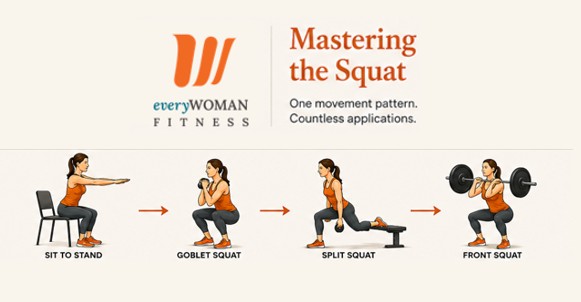
Butt to Chair: The chair provides confidence, consistency, and an external target while you learn the basic movement pattern.
Air Squat: Once you're comfortable with the pattern, removing the chair develops balance, confedence, and body awareness while strengthening the same movement.
Goblet Squat: Holding a dumbbell (or kettlebell) close to your body introduces meaningful resistance while naturally encouraging an upright posture and excellent squat mechanics.
Back Squat: Once technique is well established, the barbell-based back squat allows progressive loading to build substantial strength, support bone health, and continue challenging the squat pattern for years to come.
Not everyone needs to perform back squats to be healthy. But having the option to progressively increase resistance is one reason the back squat remains one of the most effective lower-body strengthening exercises available.
Other Members of the Squat Family
Many other exercises build on the same movement pattern while emphasizing slightly different skills. Here's a list of Alternative Squat Exercises, and why we use it.
Split Squat: Improve single-leg strength and stability.
Bulgarian Split Squat: Increase unilateral strength and challenge balance and hip mobility.
Step-Ups and Step-Downs: Build the strength and control needed for stairs, hiking, and daily life.
Forward, Reverse, Lateral, and Slider Lunge: Improve strength and control in multiple directions.
Wall Sit: Develop isometric strength and muscular endurance.
Bounding Holds and Box Jump Landings: Train power, balance, coordination, and force absorption.
Squat Depth: How Low Should You Go?
One of the most common questions we hear is, "How deep should I squat?"
The answer depends on your mobility, comfort, goals, training experience, and medical history. A comfortable partial squat can be an excellent place to begin. As strength, balance, and mobility improve, many people naturally become comfortable moving deeper. There is no prize for forcing deeper motion or advancing to a heavy, loaded back squat. Your best gains occur when you move well through the range of motion that's appropriate for you while gradually expanding your options over time in a manner well tolerated by your body.
Squats: More Than a Gym Exercise
The squat movement pattern allows us to rise from a chair, climb stairs, lower ourselves to the floor, carry groceries, garden, hike, ski, run, and continue participating in the lives we want to live.
At Every Woman Fitness, we don't teach squats because they're trendy or because everyone should lift a barbell. We teach them because practicing this fundamental movement today helps preserve independence, confidence, and capability for decades to come.
Squats are a fundamental part of each of our Strength Training Programs for Women Over 40.
References:
Currier BS, D'Souza A, Fiatarone Singh MA, et al. American College of Sports Medicine Position Stand. Resistance Training Prescription for Muscle Function, Hypertrophy, and Physical Performance in Healthy Adults: An Overview of Reviews. Medicine & Science in Sports &Exercise. 2026;58(4):851-872.
American College of Sports Medicine. ACSM's Guidelines for Exercise Testing and Prescription. 12th ed. Philadelphia, PA: Wolters Kluwer; 2025.
Suchomel TJ, Nimphius S, Stone MH. The Importance of Muscular Strength in Athletic Performance. Sports Medicine. 2016;46:1419-1449.
Nelson ME, Rejeski WJ, Blair SN, et al. Physical Activity and Public Health in Older Adults: Recommendation from the American College of Sports Medicine and the American Heart Association. Medicine & Science in Sports & Exercise. 2007;39(8):1435-1445.
Janssen WGM, Bussmann HBJ, Stam HJ. Determinants of the Sit-to-Stand Movement: A Review. Physical Therapy. 2002;82(9):866-879.
Lord SR, Murray SM, Chapman K, Munro B, Tiedemann A. Sit-to-Stand Performance Depends on Sensation, Speed, Balance, and Psychological Status in Addition to Strength in Older People. The Journals of Gerontology Series A: Biological Sciences and Medical Sciences. 2002;57(8):M539-M543.