The Five Pillars of Healthspan
Many aspects of aging are more modifiable than we once believed. The Five Pillars of Healthspan are strength, endurance, balance, mobility, and connection. Together, they provide a practical framework for maintaining independence, resilience, and quality of life as we age. Learn how each pillar contributes to healthy aging and why small, consistent investments in these areas can help you stay active, capable, and engaged in the years ahead.
In our previous article, we introduced the concept of healthspan—the years of life spent healthy, active, independent, and able to participate fully in the activities and relationships that matter most to us.
We also discussed an encouraging reality: while none of us can control our birth date or our genetics, many of the factors that influence how we age are surprisingly responsive to our actions.
In other words, many aspects of healthspan are modifiable. That doesn't mean we can guarantee perfect health or completely avoid the challenges that come with aging. It does mean that our daily choices influence how we move, function, recover, connect, and engage with the world around us.
At Every Woman Fitness, we think of these modifiable factors as the Five Pillars of Healthspan.
Pillar 1: Strength
Can my body comfortably meet the physical demands of my daily life?
While the word strength may spark images of young athletes in crowded weight rooms, we see strength as a life skill.
Strength allows us to carry groceries, lift luggage, climb stairs, get up from the floor, move furniture, shovel snow, pick up grandchildren, and navigate the physical demands of daily life with confidence. Strength produces more than nice looking muscles. Research links strength training to improvements in bone health, physical function, balance, metabolic health, and independence as we age.
One of the most encouraging findings in exercise science is that strength remains highly trainable throughout life. Even people who begin strength training later in adulthood can make meaningful improvements in function and quality of life. Read why strength training is especially important to women as we age.
When we think about strength, we aren't thinking about the weight room. We're thinking about the freedom that strength creates.
Pillar 2: Endurance
Can I do the activities I enjoy without fatigue becoming the limiting factor?
Endurance allows us to keep moving.
It helps us walk through airports, explore new cities, attend social functions, chase grandchildren through the yard, and enjoy long days doing the activities we love.
Cardiovascular fitness is associated with lower risk for many chronic diseases, but its benefits extend far beyond disease prevention. Endurance often determines whether an activity feels energizing or exhausting, inviting or intimidating. While our strength programs will help you increase your endurance, their primary role is to give you the strength to safely and efficiently improve your endurance through cardiovascular pursuits and heavier activities of daily living.
Pillar 3: Balance and Coordination
Can I move confidently through a changing and unpredictable world?
Many people don't think about balance until they begin to lose it. Then they find that balance affects confidence. It affects freedom. It affects our willingness to engage with the world around us. When balance declines, people often begin avoiding activities they once enjoyed. Uneven trails become intimidating. Winter sidewalks become stressful. New physical challenges feel risky rather than exciting.
Unfortunately, avoiding these experiences often accelerates the problem. The less we challenge our balance systems, the fewer opportunities we have to maintain or improve them.
Fortunately, balance remains trainable throughout life. The nervous system continues adapting when appropriately challenged. With practice, many people can improve balance, coordination, and confidence well into older adulthood.
The goal isn't perfect balance.
The goal is maintaining the freedom to keep exploring, moving, and participating in life.
Pillar 4: Mobility
Do my joints and muscles allow me to move comfortably through daily life?
Mobility may spark mental pictures of performing impressive stretches or moving like a gymnast. In common reality though, mobility is simply having enough movement available to do the things your life requires.
For one person, that may mean gardening comfortably. For another, it may mean getting on and off the floor, reaching overhead, looking over a shoulder while driving, skiing, hiking, or playing pickleball.
Mobility needs are highly individual because our lives are highly individual. We do not need to achieve some universal standard of flexibility. The key is maintaining enough movement options to participate comfortably and safely in the activities that matter to you.
Like the other pillars, mobility tends to improve when we use it and decline when we stop challenging it.
Maintaining mobility helps keep doors open.
Both literally and figuratively.
Pillar 5: Connection
Am I maintaining relationships and communities that enrich my life?
This pillar may be the most overlooked. When people think about healthy aging, they often think about exercise, nutrition, or medical care. They rarely think about connection. However, A growing body of research suggests that social connection plays an important role in physical health, emotional well-being, cognitive function, and longevity.
Humans are social creatures.
We tend to thrive when we feel connected to family, friends, communities, teammates, training partners, volunteer organizations, faith communities, or shared interests. The specific source of connection matters less than the sense of belonging.
Many of us have experienced periods of life when connection came easily. We have also experienced times when maintaining relationships required more effort. Like strength, endurance, balance, and mobility, connection often benefits from intentional practice.
A coffee date.
A walking partner.
A workout buddy.
A weekly phone call.
Small investments can create meaningful returns.
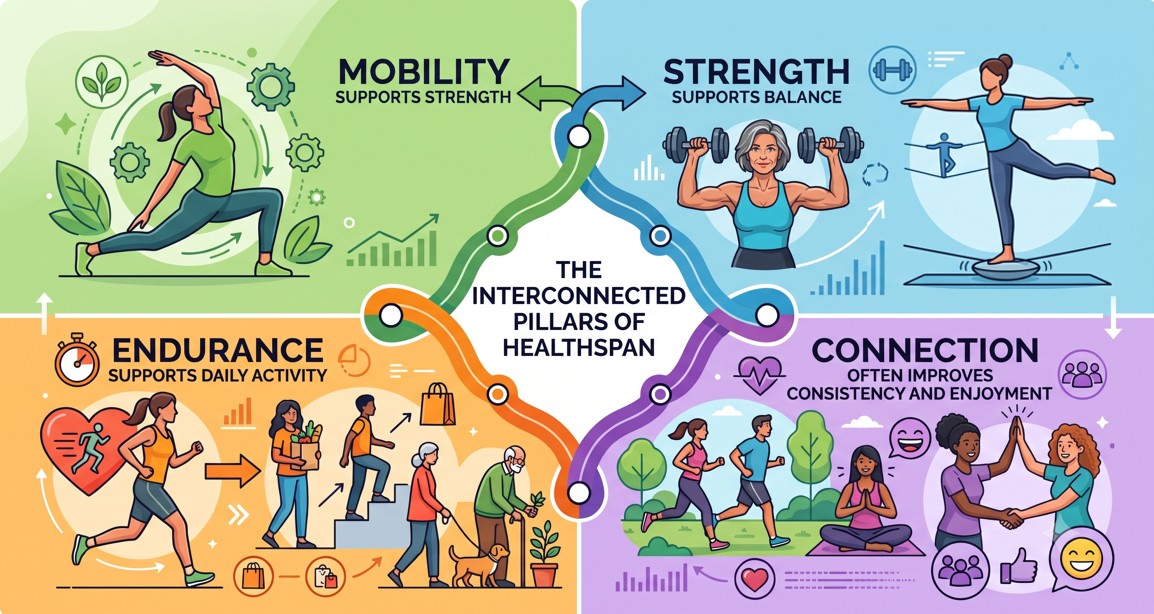
The Pillars Work Together
Although we've described these pillars separately, they rarely operate independently.
Strength supports balance.
Mobility supports strength.
Endurance supports daily activity.
Connection often improves consistency and enjoyment.
A walking group can improve both endurance and social connection. A strength-training program can improve strength, balance, and mobility simultaneously. Recreational sports often challenge all five pillars at once.
The pillars are interconnected because people are interconnected systems.
When one pillar improves, positive changes often ripple into the others.
The Bottom Line
None of us can stop aging.
What we can do is influence many of the factors that determine how we experience the years ahead.
The Five Pillars of Healthspan—strength, endurance, balance, mobility, and connection—represent areas where our actions matter. They are not the only contributors to healthy aging, but they are among the most modifiable and meaningful.
At Every Woman Fitness, we aim for our healthspans to be every bit as long as our lifespans. The Five Pillars provide a practical framework for pursuing that goal.
Not perfectly.
Not all at once.
But one workout, one walk, one adventure, and one connection at a time.
Check out our strength training programs designed for women over 40 if you are interested in building the pillars of your healthspan.
References
Rowe JW, Kahn RL. Successful Aging. Gerontologist. 1997;37(4):433-440.
Kaeberlein M. How healthy is the healthspan concept? NPJ Aging and Mechanisms of Disease. 2018;4:21.
American College of Sports Medicine. Physical Activity Guidelines and Position Stands for Older Adults.
Sherrington C, Fairhall NJ, Wallbank GK, et al. Exercise for preventing falls in older people living in the community. Cochrane Database of Systematic Reviews. 2019.
Bull FC, Al-Ansari SS, Biddle S, et al. World Health Organization 2020 Guidelines on Physical Activity and Sedentary Behaviour. Br J Sports Med. 2020;54:1451-1462.
Holt-Lunstad J, Smith TB, Layton JB. Social Relationships and Mortality Risk: A Meta-analytic Review. PLoS Medicine. 2010;7(7):e1000316.
Office of the Surgeon General. Our Epidemic of Loneliness and Isolation: The U.S. Surgeon General's Advisory on the Healing Effects of Social Connection and Community. 2023.