What Is Healthspan?
Most of us hope to live a long life. But just as important is how well we live during those years. Healthspan refers to the years we remain active, capable, independent, and engaged in the activities and relationships that matter most to us. In this article, we explore the difference between lifespan and healthspan, why many aspects of aging are more modifiable than people realize, and how small investments in health can pay dividends for decades.
What is Healthspan? Healthspan is more than just avoiding disease. Rather, it refers to the years we remain active, capable, independent, and engaged in the activities and relationships that matter most to us.
In this article, we explore the difference between lifespan and healthspan, why many aspects of aging are more modifiable than people realize, and how small investments in health can pay dividends for decades.
A Founder's Note From Nikki
When I raced my first 100-kilometer road running National Championship in 2001, I met a man who was there crewing for another runner. As we chatted, he mentioned that he had several ultramarathons of his own planned later in the season and that the runner he was supporting that day would return the favor and crew for him.
At some point in the conversation, he casually mentioned that he was 80 years old. Certain that I had misheard him, I asked to see his driver's license.
He wasn't joking.
At the time, I was 30 years old and still thought of 80 as an age when people slowed down, stayed close to home, and reminisced about adventures they had completed long ago. Yet here stood a man making plans for future ultramarathons.
Over the years, both Kami and I have met many people like him. Some were serious athletes. Others simply lived active, engaged lives. Exceptional athletic talent was not prerequisite to exceptional healthspan. Rather, what linked these long-healthed people was a passion for physical, mental, and social activity.
Those encounters helped shape the way we think about aging. While we cannot choose exactly how long we live, most of us have more influence than we realize over how well we live the years we have.
Lifespan Versus Healthspan
In recent years, researchers, healthcare providers, and fitness professionals have begun using a term that captures an idea many of us intuitively understand: healthspan.
Lifespan is simply how long you live.
Healthspan is how long you live with the strength, mobility, energy, independence, and resilience to fully participate in your life.
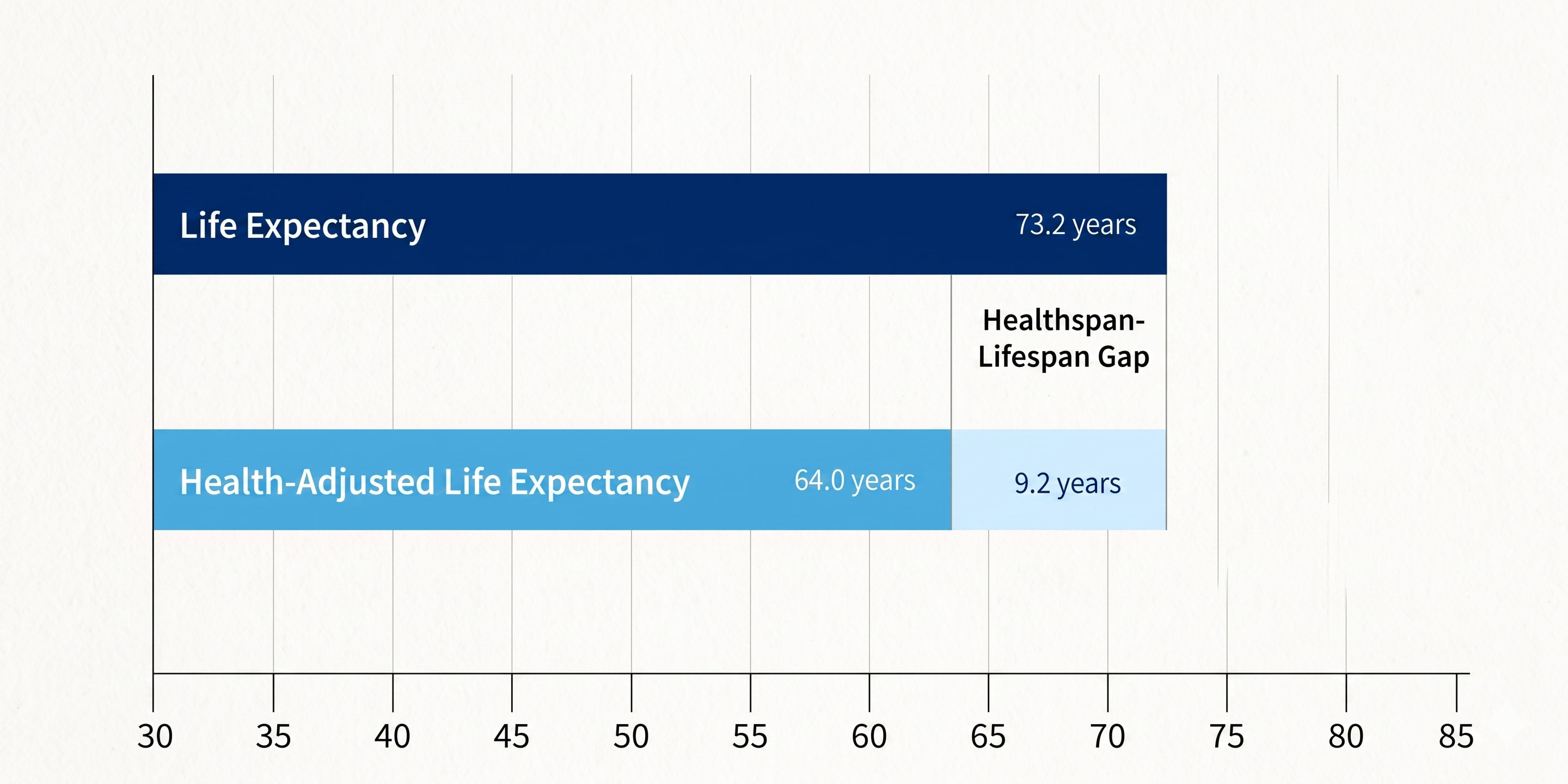
The average gap between healthspan and lifespan in the US in 2019 was a world-leading 12.4 years, and that gap represented a 13% increase versus that seen in 2000. The average global gap is 9.6 years, with women, on average suffering 2.4 more gap years than men.
Most of us know people who have lived into their 80s or 90s. Some remained active, engaged, and independent for decades. Others spent many of those years limited by chronic illness, pain, reduced mobility, or loss of independence. Observing these potential outcomes leads one to ask:
"How can I build a body and mind that continue to support the life I want to live?"
More Than Avoiding Disease
Traditional healthcare often focuses on diagnosing and treating disease. Those efforts are important, but healthspan takes a broader view of what it means to age well.
A long healthspan includes the ability to move confidently through daily life, maintain meaningful relationships, continue participating in activities you enjoy, and remain physically and mentally capable as the years pass. It includes strength to lift and carry, balance to navigate uneven terrain, bone density that supports an active lifestyle, cardiovascular fitness that allows you to walk, hike, travel, and play, and mobility that helps you move comfortably through the tasks of everyday life. Just as importantly, healthspan includes cognitive health, emotional well-being, curiosity, purpose, and social connection.
These qualities rarely disappear overnight. More often, they gradually improve or decline based on the habits we build over years and decades.
The Good News
Though none of us can control our genetics, many of the factors that influence how we age are modifiable.
Muscle responds to strength work. Bone responds to loading (read our article referencing appropriate loading for bone health). Balance, cardiovascular fitness, and mobility can improve with appropriate training. Social connections can be cultivated and maintained. Even later in life, people can often improve physical function, confidence, and quality of life through intentional action.
Why We Share a Love of Strength Work
Every Woman Fitness focuses on strength training because it influences so many aspects of healthspan simultaneously. Strength training can help preserve muscle mass, support bone density, improve balance, enhance metabolic health, and maintain the physical capacity needed for daily life. It is difficult to think of another form of exercise that affects so many healthspan-related qualities at the same time.
That does not mean strength training is the only important activity. Walking, running, group social activities, gardening, recreational sports, and countless other activities contribute to a healthy and active life. Strength training simply provides a foundation that helps many people continue participating in those activities as the years pass.
Healthspan Training Versus Performance Training
Kami and Nikki spent decades pursuing elite athletic performance. They understand the appeal of chasing ambitious goals, testing limits, and seeing what the human body can do.
In many ways, healthspan training looks remarkably similar. Recovery matters. Consistency matters. Injury resilience matters. Strength, endurance, balance, mobility, and social connection all contribute to both athletic performance and a vibrant life.
The difference lies primarily in the goal. Performance training is designed to maximize performance in a specific event. Training often becomes highly specialized, with carefully prescribed workouts focused on developing the qualities most important for success in that sport.
Healthspan training leads toward broader goals. Rather than preparing for a single competition, it prepares us for a lifetime of adventures, challenges, and everyday experiences. That often means embracing more variety, more spontaneity, and more opportunities to simply enjoy movement.
Naturally, exercise can be difficult. Fortunately, exercise for health isn’t an exacting, high-pressure activity. It includes endless variety. It can be done alone or with others, and fun can be a primary goal. Complete your EWF workout with a friend, explore a new trail, try a different activity, or take the scenic route on your next walk. Healthspan training is practice for an active life: one filled with travel, hobbies, adventures, relationships, and whatever new opportunities capture your imagination next.
Read how training changes as we age, and how a change of mindset can help.
Our Goal
At Every Woman Fitness, we often talk about a simple goal for ourselves and others: make our healthspans to be every bit as long as our lifespans.
We want to continue contributing to family and friends. We want to continue adventuring and learning. We want to complete our everyday tasks without injury or exhaustion that limits our ability enjoy the fun stuff. We to minimize time spent in pain or dependent on others.
That, to us, is what healthspan is really about.
The Bottom Line
Healthspan is about preserving the physical, mental, and social capacities that allow us to participate fully in our lives.
For some people, that means skiing, hiking, gardening, or traveling. For others, it means carrying groceries with confidence, getting up from the floor with ease, keeping up with grandchildren, or remaining independent in their own homes. Most of us will find that our goals evolve over time, but the underlying desire remains remarkably consistent: we want bodies and minds that support the lives we want to live.
In our next article, we'll introduce the Five Pillars of Healthspan: key areas where our daily actions can meaningfully influence how we experience the years ahead.
Reference
Rowe JW, Kahn RL. Human aging: usual and successful. Science. 1987 Jul 10;237(4811):143-9. doi: 10.1126/science.3299702. PMID: 3299702.
Garmany A, Terzic A. Global Healthspan-Lifespan Gaps Among 183 World Health Organization Member States. JAMA Netw Open. 2024;7(12):e2450241. doi:10.1001/jamanetworkopen.2024.50241